Baptism
This reflection on baptism reveals its spiritual meaning in the light of the fullness that was fulfilled in Christ.
Airton Humber · 28/10/25 · 5 min de leitura
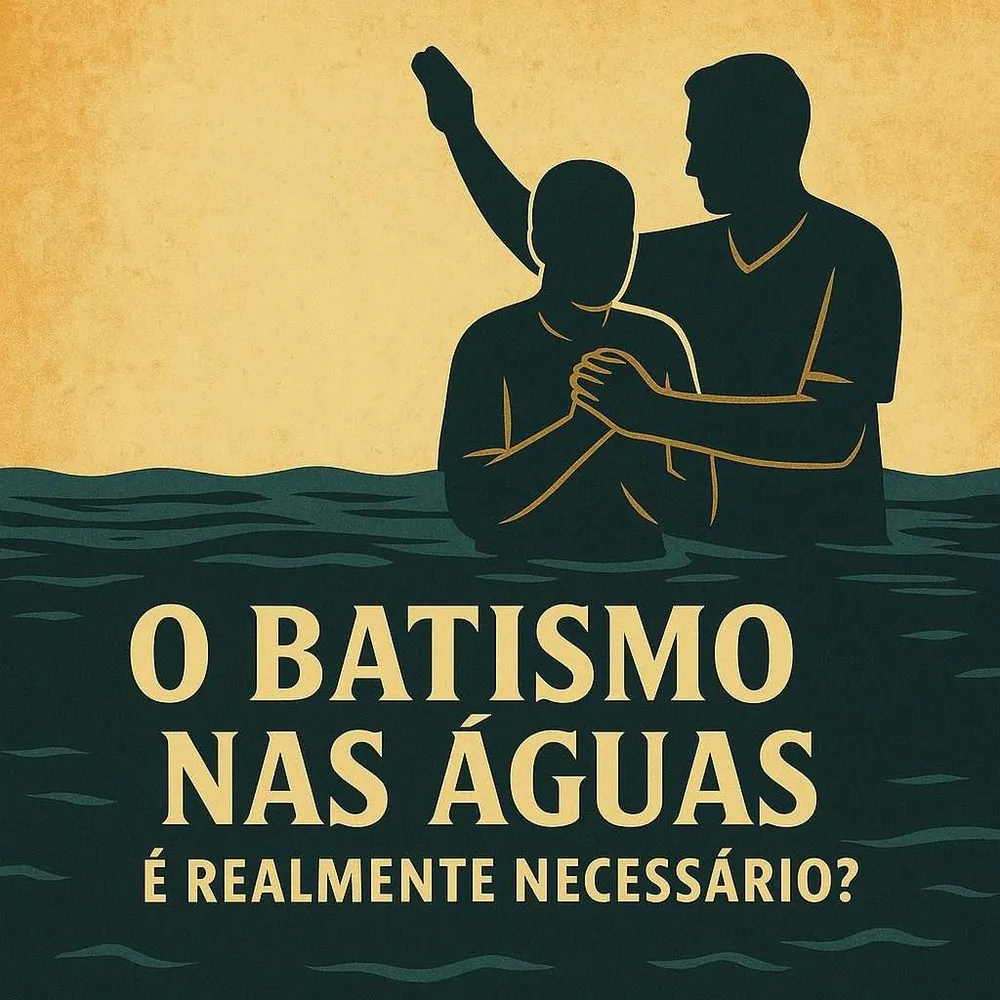
Baptism in water
Is it really necessary?
This reflection does not intend to devalue water baptism, but to reveal its spiritual meaning in the light of the fullness that was fulfilled in Christ. The intention is simple: to return to Scripture, without human doctrines, to understand what it really is to be born of water and of the Spirit.
💧 1. A Jewish rite of purification
Long before John the Baptist, the people of Israel already practiced ceremonial washings with water. These rites were part of the purification laws given to Moses, a way of preparing oneself outwardly for worship.
The priests washed before entering the temple, and even the Gentiles who wished to become Jews had to go through a ritual bath (tevilah).
These purifications were shadows of the old covenant, visible signs of the search for purity before God, but they pointed to something greater: the true inner purification that only the Spirit could accomplish.
🕊️ 2. John the Baptist and the baptism of repentance
When John appears in the desert, he does not create a new rite, he only gives new meaning to the old one. His baptism in water represented repentance: a change of heart and of direction.
“I baptize you with water, for repentance. But after me comes one more powerful than I… He will baptize you with the Holy Spirit and with fire.” (Matthew 3:11)
🌊 3. The baptism of Jesus and the transition from symbol to reality
Jesus, when He was baptized, did not do it out of repentance, but to fulfill all righteousness, that is, to confirm God's plan and open the way of the Spirit.
When He comes up out of the water, the Holy Spirit descends on Him. The outward sign meets the spiritual reality. There the cycle of rituals ends and the age of the Spirit begins: the water represents the death of the old man, and the Spirit brings the life of the new.
✡️ 4. Baptism and the Jews
John's baptism was directed to the people of Israel, calling them back to God. It was a call to national repentance, a preparation to receive the Messiah.
For this reason, the first Christians, all Jews, continued baptizing in water. It was natural: that symbol was part of their spiritual culture. But the purpose was never salvation by water, but rather the public expression of faith in Christ.
🌿 5. The Spirit is poured out on the Gentiles without water
In Acts 10, we find the divine turning point: Cornelius and his household, devout Gentiles, heard the gospel preached by Peter, and even before being baptized in water, the Holy Spirit came upon all of them.
“While Peter was still speaking, the Holy Spirit came on all who heard the message.” (Acts 10:44)
“Can anyone withhold the water, preventing these who, like us, have received the Holy Spirit from being baptized?” (Acts 10:47)
⚖️ 6. Paul: from symbol to substance
Paul, the apostle to the Gentiles, rarely speaks of water baptism. And when he does, it is as a spiritual figure, not as a mandatory rite.
“For we were all baptized by one Spirit, forming one body.” (1 Corinthians 12:13)
“Christ did not send me to baptize, but to preach the gospel.” (1 Corinthians 1:17)
🔥 7. Circumcision and water baptism: spiritual parallels
For the Jews, circumcision was the physical sign of the covenant. But Paul teaches that, in Christ, the true sign is the circumcision of the heart, done by the Spirit.
“In Christ you were circumcised, not by human hands, but with the circumcision done by Christ, having been buried with him in baptism.” (Colossians 2:11–12)
⚔️ 8. The discussion between Paul and Peter: the end of rituals as a requirement
The attempt to circumcise the Gentiles provoked the first great theological conflict of the church. Some converted Jews insisted that the Gentiles should keep the Law of Moses and be circumcised in order to become part of God's people (Acts 15:1).
“God, who knows the heart, showed that he accepted them by giving the Holy Spirit to them, just as he did to us.” (Acts 15:8)
“Now then, why do you try to test God by putting on the necks of the disciples a yoke that neither we nor our ancestors have been able to bear?” (Acts 15:10)
“Knowing, however, that a person is not justified by the works of the law, but by faith in Jesus Christ…” (Galatians 2:16)
“I have been crucified with Christ; and I live, no longer I, but Christ lives in me.” (Galatians 2:20)
Just as circumcision could not be imposed on the Gentiles, so too no physical rite can be imposed as a condition for the Spirit. What saves is living faith in Christ, which produces repentance, transformation and the seal of the Holy Spirit.
💧 9. “Born of water and of the Spirit”: the dialogue with Nicodemus
“Whoever is not born of water and of the Spirit cannot enter the Kingdom of God.” (John 3:5)
Jesus was speaking with Nicodemus, a Jewish teacher familiar with the rituals of purification. He was referring to the promise of Ezekiel 36:25–27:
“I will sprinkle clean water on you, and you will be purified… I will put my Spirit in you.” (Ezekiel 36:25–27)
“Born of water” is to be purified within; “born of the Spirit” is to receive new life. It is not about a physical rite, but about an inner work of the Holy Spirit.
📖 10. “The doctrine of baptisms”: Hebrews and the maturing of faith
“Instruction about baptisms… are elementary principles.” (Hebrews 6:1–2)
“They are only external regulations applied until the time of the new order.” (Hebrews 9:10)
For the author of Hebrews, spiritual maturity begins when we leave behind the external rites and move toward the inner reality of the Spirit.
🌅 11. Baptism into death and resurrection: the inner reality
“We were buried with him through baptism into death, so that, just as Christ was raised, we too may live a new life.” (Romans 6:4)
This baptism happens in Christ, not in the water. It is the plunge of the soul into the death of the ego and into the birth of the new creation. The pool symbolizes; the Spirit accomplishes.
✨ 12. Baptism in water: a symbol, not a prerequisite
“Today you will be with me in paradise.” (Luke 23:43)
“Having believed, you were sealed with the promised Holy Spirit.” (Ephesians 1:13)
God looks at the heart, not the ritual. The Spirit is given to the one who believes, repents and surrenders, with or without water. Water may accompany faith, but never replace it. The Spirit is the reality; the water is only the reflection.
🤍 13. Conclusion: From rite to spiritual reality
Baptism in water was instituted within the Jewish context and fully fulfilled in Christ. For the Gentiles, it is not a biblical prerequisite, but a symbolic tradition that expresses a faith already present.
“Whoever is baptized in water, let him do it by faith; whoever does not, let him not feel condemned. Because the Father seeks worshippers in Spirit and in truth.” (John 4:23)
The water purified the body,
John touched the heart,
and the Spirit transformed the being.
🔥 Postscript: The fire and the light
Just a few centuries ago, an article like this would have been considered heresy.
Not for denying the faith, but for affirming that the Holy Spirit is not limited to water, to the temple or to the rite, and that God does not depend on human hands to act.
Men who said the same were persecuted, burned or silenced.
But the fire that consumed them did not put out the truth, it only purified it.
Today, that same fire burns in another way:
not on the outside, but inside the hearts of those who seek the truth.
The fire that once burned bodies now illuminates consciences.
The Spirit who was once feared is now known, and dwells in us.
“The wind blows where it wishes… so it is with everyone who is born of the Spirit.” (John 3:8)