Food Fasting: A Scientific Approach
There has never been so much food available, and there have never been so many problems related to eating. Where does fasting come in?
Airton Humber · 20/12/25 · 4 min de leitura

Introduction
We live in a historical contradiction.
There has never been so much food available, and there have never been so many problems related to eating.
On one side, hunger.
On the other, excess.
In the middle, ultra-processed foods, continuous consumption and a human body that was not designed to eat all the time.
In this scenario, fasting usually appears wrapped in religious, moral or ideological discourse. But when we remove those filters, something very simple is left:
What happens in the human body when it goes a while without eating?
This is a scientific question.
And this text is built from it.
What fasting is, from a scientific point of view
Fasting is the voluntary suspension of caloric intake for a period longer than the usual interval between meals.
It is not punishment.
It is not virtue.
It is not a miracle method.
It is simply the human body functioning outside the constant fed state, something biologically normal throughout most of human history.
The human body was designed to alternate states
Throughout practically all of human existence, the pattern was simple:
-
eat when there was food
-
go hours or days without eating when there was none
The organism learned to:
-
store energy
-
use that energy
-
enter saving mode
-
activate natural mechanisms of adaptation and maintenance
The modern problem is not fasting.
It is the complete absence of metabolic pauses.
What happens in the body during fasting
Fed state × Fasted state
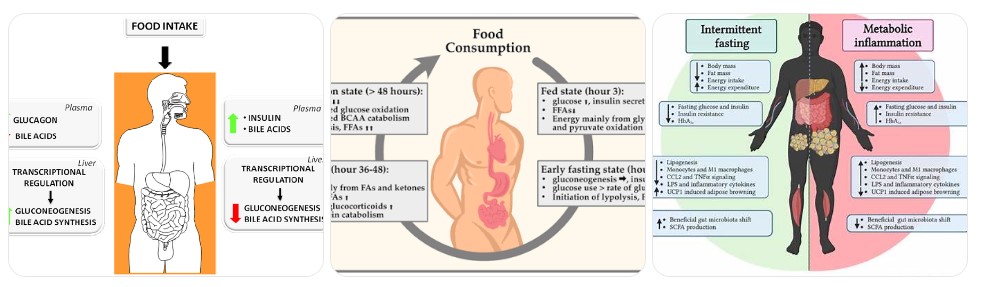
By reducing caloric intake, the body leaves the constant storage mode and starts using stored energy, activating natural mechanisms of adaptation.
Drop in insulin
Insulin is the storage hormone.
When we eat all the time, it stays elevated.
In fasting:
-
insulin drops
-
the body leaves "store" mode
-
and enters "use" mode
This allows:
-
greater fat burning
-
improved metabolic sensitivity
-
reduction of low-grade inflammation
All of this is measurable in laboratory tests.
Using fat as fuel
After liver glycogen is depleted, the organism starts using fat as its main source of energy.
This process is called metabolic flexibility, the ability to switch between glucose and fat.
People who never take breaks from eating tend to lose this ability.
Autophagy: cellular cleaning
Autophagy literally means "the cell recycling itself."
During fasting:
-
defective proteins are broken down
-
damaged cellular structures are removed
-
the accumulation of cellular waste decreases
This mechanism is so relevant that it was recognized with the Nobel Prize in Medicine.
It is not mysticism.
It is biological maintenance.
Short fasting versus prolonged fasting
Metabolic timeline of fasting
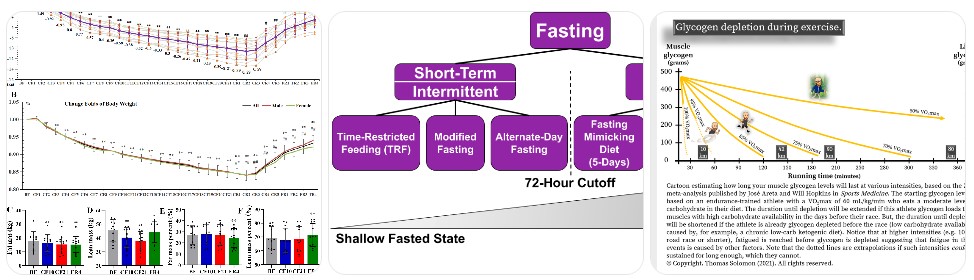
The body does not change state all at once. Fasting works in phases, with different benefits and risks depending on the time.
Short fast (12 to 24 hours)
It is the most studied, safe and sustainable.
Most common effects:
-
drop in insulin
-
start of autophagy
-
metabolic improvement
-
greater mental clarity
-
low physiological stress
It works as metabolic hygiene, similar to rest or sleep.
Intermediate fast (24 to 48 hours)
Here fasting stops being just maintenance and becomes intervention.
Possible benefits:
-
increased autophagy
-
more intense reduction of inflammation
Possible costs:
-
drop in blood pressure
-
greater need for electrolytes
-
increased physiological stress in some profiles
It is not a practice for routine.
Prolonged fast (over 48–72 hours)
Although it strongly activates autophagy, it involves real risks:
-
loss of muscle mass
-
electrolyte imbalance
-
reduction of basal metabolism
-
hormonal impact
It is not a population health strategy.
It only makes sense in supervised clinical contexts.
More time does not mean more benefit.
Fasting and the Nervous System
Fasting and the brain
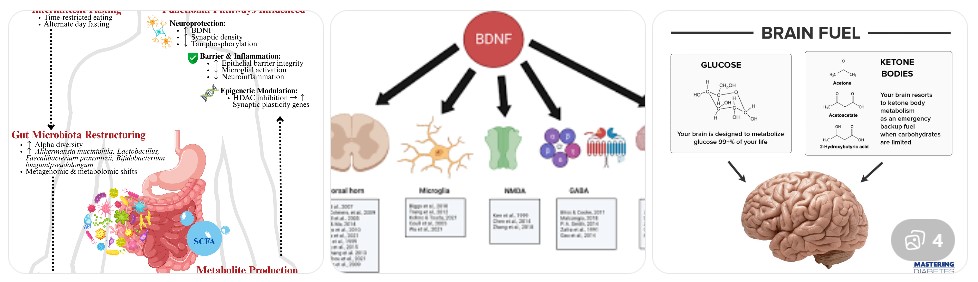
During fasting, the brain does not lose energy. It changes the type of fuel and the neurochemical state, favoring clarity, adaptation and efficiency.
Reduction of brain metabolic noise
Smaller fluctuations in glucose and insulin reduce neural inflammation.
This is usually noticed as:
-
a clearer mind
-
less "brain fog"
-
greater emotional stability
Ketone bodies and brain efficiency
During fasting, the brain starts partially using ketone bodies:
-
more stable energy
-
lower oxidative stress
-
better mitochondrial efficiency
This explains the increase in focus reported by many people.
Increase in BDNF
Fasting stimulates BDNF, an essential factor for:
-
neural plasticity
-
memory
-
learning
-
emotional adaptation
Low levels of BDNF are associated with depression and cognitive decline.
Autonomic nervous system: alert without panic
Short fasting lightly activates the sympathetic system:
-
more vigilance
-
more attention
This is not anxiety.
Anxiety arises when stress is excessive or prolonged.
When fasting becomes neural stress
The body always warns:
-
mental confusion
-
intense weakness
-
persistent irritability
-
worse sleep
This is not adaptation.
It is neuroendocrine dysregulation.
The most common mistake: turning fasting into a rule
Fasting is not:
-
a moral virtue
-
proof of discipline
-
a universal solution
It is only:
a physiological tool for metabolic rest
Tools need context, limits and common sense.
Consistency beats intensity.

Conclusion
From a scientific point of view, fasting is an interval without food that allows the body to activate natural mechanisms of balance, adaptation and cleaning.
In a world marked by scarcity, excess and poor food quality, perhaps the greatest value of fasting is not in "going without eating," but in relearning to give the body pauses.
Credits: CHATGPT
Learn more: BDNF What is it?