God's Co-workers
Objective, diagnosis and action plan: a reflection on cooperation, the Holy Spirit and Christ in us, the hope of glory.
Airton Humber · 27/05/26 · 8 min de leitura

Objective, diagnosis and action plan in the process of transformation
Introduction
In business planning I learned something important.
When threats and weaknesses take up too much space, objectives begin to lose clarity. The analysis grows, the worry grows and, curiously, action shrinks.
The planning becomes paralyzed.
It was curious to realize that perhaps we do exactly the same in the spiritual life.
We have an enormous ease in looking at risks, problems, limitations, mistakes and threats. And that is not necessarily bad. Every true change requires honesty and a correct diagnosis.
But there is an important detail: the diagnosis should never take the place of the objective.
Without an objective, the diagnosis becomes a burden.
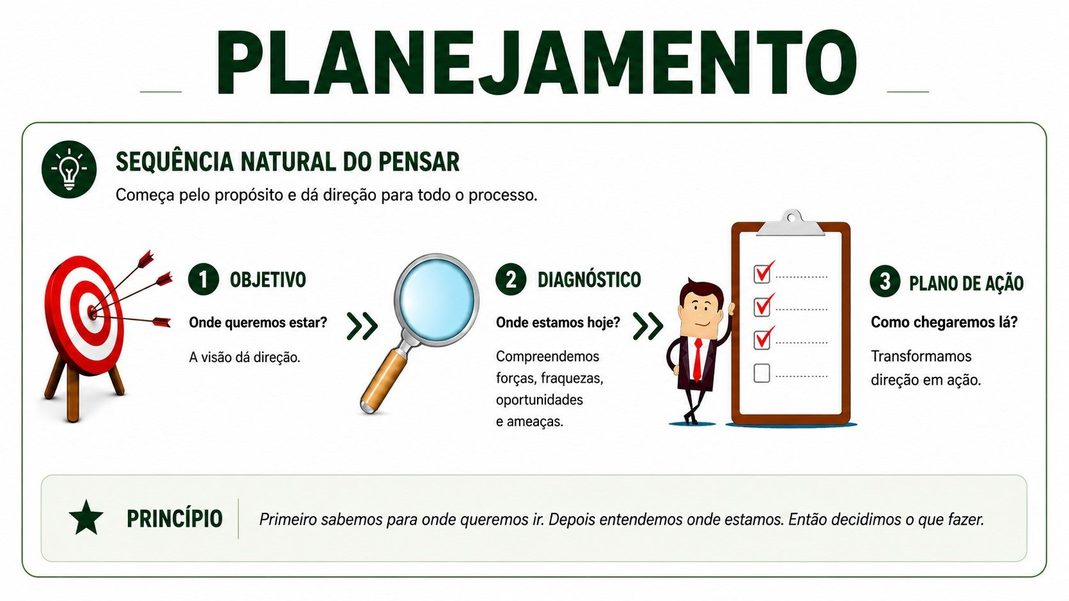
In the business world, we usually work with three simple steps:
Objective.
Diagnosis.
Action plan.
Curiously, the Scriptures also seem to reveal something similar. Not as a human technique, but as a living process of transformation.
And perhaps the first human mistake is to invert this order.
We start with the problem. With the threat. With the weakness. With fear.
But healthy planning, human or spiritual, starts with vision.
“Where there is no vision, the people are corrupted…”Proverbs 29:18
Perhaps this corruption is not only moral. Without vision, we also scatter. We lose direction. We go back to what is familiar. We start to react instead of walking.
1. The objective
Every true transformation begins with the right question:
Where are we going?
What is our objective?
Without this answer, the diagnosis spreads in every direction.
Perhaps here there is an important reflection.
For many Christians, when we ask about the objective of faith, the answer is usually simple:
to go to heaven.
This does not need to be treated as criticism.
Only as a sincere question about objectives.
Because, if the objective defines the diagnosis and the action plan, then understanding it correctly becomes decisive.
And perhaps here the Scriptures invite us to look a little more deeply.
Jesus speaks repeatedly of the Kingdom of God.
Of the Father's will.
Of life.
Of the new birth.
Of the Spirit.
Of fruit.
Of abiding.
And, when he teaches us to pray, he does not say:
“Take us to your Kingdom…”
But:
“Your Kingdom come;
your will be done,
on earth as it is in heaven.”
Perhaps this does not eliminate future hope.
But it shifts the center of attention.
Not only where we will go.
But what God desires to accomplish in us and through us right now.
Perhaps the objective revealed by the Scriptures is not only a place.
But a Life.
A communion.
A government of the Spirit transforming and forming something new in us.
The whole Bible seems to have this axis.
The Old Testament prepares, announces and points to Christ revealed in Jesus.
And the New Testament, especially through the apostle Paul, insists on revealing the implications of this work.
Not only who Christ is.
But what it means for his life to dwell in us.
Perhaps that is why the objective is not simply religion, behavior or spiritual performance.
The objective is Christ.
Because only God is good.
He is Lord.
He is Father.
And his will is good, pleasing and perfect.
But perhaps here there is a decisive question:
“What must we do to perform the works that God requires?”John 6:28
Jesus' answer was surprisingly simple:
“The work of God is this: to believe in the one he sent.”John 6:29
This shifts the center of human effort.
The work of God does not begin in our ability to produce spirituality.
It begins in trust.
In faith.
In relationship.
Jesus is the one sent by the Father.
And, after him, the Holy Spirit is sent to remain with us and lead the work of God in us.
It is the Spirit who convicts.
Who reveals our mistakes and our invisible filters.
Who strengthens.
Who guides into all truth.
Who teaches all things, but at the right time.
Who produces the fruit.
Who equips with his gifts.
Who continues the work we do not know how to accomplish alone.
“For it is God who works in you both to will and to do…”Philippians 2:13
Perhaps that is why Paul insists so much:
Christ being formed.
New creation.
One Spirit.
Until he sums it all up in an extraordinarily simple phrase:
“Christ in you, the hope of glory.”Colossians 1:27
The objective comes before the diagnosis.
And the work comes before the effort.
Without this vision, even the truth can become heavy.
2. The diagnosis
If the objective shows us where we are going, the diagnosis helps us see where we are.
And here there is a simple but decisive principle:
we can only change something starting from the correct diagnosis.
In the business world this is obvious. No planning prospers based on a mistaken perception.
That is why there are simple tools for reading the scenario, such as the SWOT analysis:
Strengths.
Weaknesses.
Opportunities.
Threats.
This tool does not exist to produce fear or pessimism. It exists to produce clarity.
Strengths can be enhanced. Weaknesses can be treated. Opportunities can be noticed. Threats can be managed.
But a healthy diagnosis is not meant to occupy the center of attention. It is meant to light the way.
When threats and weaknesses begin to dominate the vision, the planning becomes paralyzed.
This happens in companies. And perhaps it happens with us too.
There is a natural attraction to threats, to risks, to what is missing, to what can go wrong. Our attention is easily captured by the problem.
And when this happens, the objectives begin to lose clarity.
The gaze fixes on fear, guilt, accusation, insecurity, the need for control.
Without noticing, the diagnosis stops being a tool and becomes a prison.
There are also silent narratives operating in us.
Family, social and religious narratives. Many times we inherit ways of seeing the world without noticing.
We do not always follow revealed truth directly. Often we follow the narratives we learned about it.
This does not need to be said as an accusation. Only as a human observation.
Over time, interpretations, traditions and structures can gain a force of their own and begin to influence our reading of reality.
“Do not conform to the pattern of this world…”Romans 12:2
Because there is a mold. And many times it is invisible.
Perhaps that is why true change is so hard.
There is in us a natural tendency to return to the familiar, even when the familiar limits us.
Israel left Egypt, but Egypt was slow to leave Israel.
The familiar offers security, even if it is narrow.
Paul does not say that the flesh only limits. He shows that it wages war. There is a dispute. Competing leadings. Different impulses.
It is not the absence of struggle. It is a real struggle.
That is why control is so seductive. Controlling seems to protect, to guarantee, to avoid suffering.
But it does not always produce peace.
Here comes an important business lesson: hygiene factors do not produce motivation, but they need to be sufficiently resolved so as not to disturb the rest of the process.
Noise needs to be dealt with. Interferences need to be noticed.
Not because they are the objective, but because they can block the objective.
Anxiety, fear, control, narratives and distraction do not produce life. But they can make its flourishing harder.
Perhaps the spiritual diagnosis does not exist to accuse us, but to honestly reveal:
what is interfering in the process.
3. The action plan
If there is an objective, and if the diagnosis reveals what interferes in the process, an inevitable question arises:
What should we do?
Perhaps here there is a surprise.
The spiritual action plan does not begin in the effort to produce God, nor in the attempt to manufacture transformation.
“For we are God's co-workers…”1 Corinthians 3:9
Co-workers.
Not controllers.
Not producers of Life.
Not substitutes for God.
Co-workers.
Control tries to guarantee the result. Cooperation takes part in the process.
In control, trust rests mainly on our ability to predict, organize and interfere.
In cooperation, there is participation, but also trust in the one who leads.
“I planted, Apollos watered, but God was the one who made it grow.”1 Corinthians 3:6
They took part. But they did not produce the life.
Jesus speaks of seeds, yeast, vine, fruit, birth.
Everything points to life at work.
The farmer works. But he does not produce the mystery of the seed.
Perhaps there is an “inner 5S”: removing excess, organizing, cleaning, sustaining what favors a healthy environment.
Not as spiritual perfectionism, but as removal of interferences.
Because many times the problem is not the absence of God.
Perhaps it is an excess of noise.
Recently, during a trip, I lived something simple and deeply revealing. There were legitimate desires, plans, expectations, and also a constant impulse to interfere and control.
The greatest effort was not acting.
It was holding back the impulse to act.
I wanted to interfere all the time. But I held back.
And it was surprising to notice that, when I stopped trying to steer everything, things began to flow in an unexpectedly harmonious way.
This did not mean passivity. Nor irresponsibility.
I was still present, attentive, taking part.
But something had changed inwardly.
Perhaps cooperating is exactly this.
Not abandoning the road. But ceasing to fight over the steering wheel.
“We do not know how we ought to pray, but the Spirit himself intercedes for us with groans that words cannot express.”Romans 8:26
Not even prayer begins fully in our competence.
The Spirit takes part in the process.
Perhaps that is why Jesus placed something so simple at the center of his prayer:
“Your will be done…”
Not as heavy resignation, but as trust.
Because only God is good. He is Lord. He is Father. And his will remains good, pleasing and perfect.
Perhaps the true spiritual action plan is not to produce more, but to cooperate better.
Not quenching the Spirit.
Not grieving the Spirit.
Allowing the process.
Renewing the mind.
Trusting.
Letting ourselves be led.
Perhaps spiritual maturity is not controlling more.
But learning to get in the way less.
4. Christ in us
Perhaps the whole Bible can be seen this way:
an objective, a diagnosis and an action plan.
The objective comes first, because without vision the diagnosis becomes a prison.
The Old Testament announces, prepares and points: promises, shadows, figures, prophets, everything converging on Christ revealed in Jesus.
But the New Testament does not end the story merely by contemplating the historical Christ.
Especially in Paul's letters, a deep insistence arises: not only who Christ is, but what it means for his life to dwell in us.
Perhaps we have lost a little of this vision.
And, when vision is lost, attention is easily captured by threats, narratives, fear and the attempt to control.
Then the diagnosis occupies the center.
Religion can become excessively concerned with rules. Society, with survival. Man, with himself.
And without noticing, we return to the familiar, even if the familiar limits us.
But Paul insists on giving us back the objective.
He speaks of new creation, renewed mind, one Spirit, Christ being formed, children led by the Spirit.
And then he sums it all up in an extraordinarily simple phrase:
“Christ in you, the hope of glory.”Colossians 1:27
Perhaps here is the center.
The objective is not only religious information.
Nor moral improvement.
Nor human effort trying to reach God.
The objective is Christ.
Christ revealed.
Christ known.
Christ formed.
Christ living in us.
Then everything finds its place.
The diagnosis stops accusing and begins to illuminate.
The action plan stops being control and becomes cooperation.
Because we are God's co-workers.
Not producers of Life.
Not owners of the process.
Co-workers.
Perhaps that is why spiritual maturity is not learning to control more, but learning to trust, renew the mind, remove interferences and stop getting in the way of what God already desires to accomplish.
Because the hope of glory is not in our ability to produce life.
Nor in the strength of our strategies.
Nor in the perfection of our efforts.
But in a simple, deep and silent reality:
Christ in us, the hope of glory.
Because perhaps glory was never only something for us to contemplate from afar.
But Christ living in ordinary human beings.