Good and Evil, Right and Wrong, Political Correctness
Have you ever mixed up Good and Evil, Right and Wrong, and Political Correctness? Still have doubts about Morality and Ethics? Understand.
Airton Humber · 16/06/25 · 4 min de leitura
Introduction
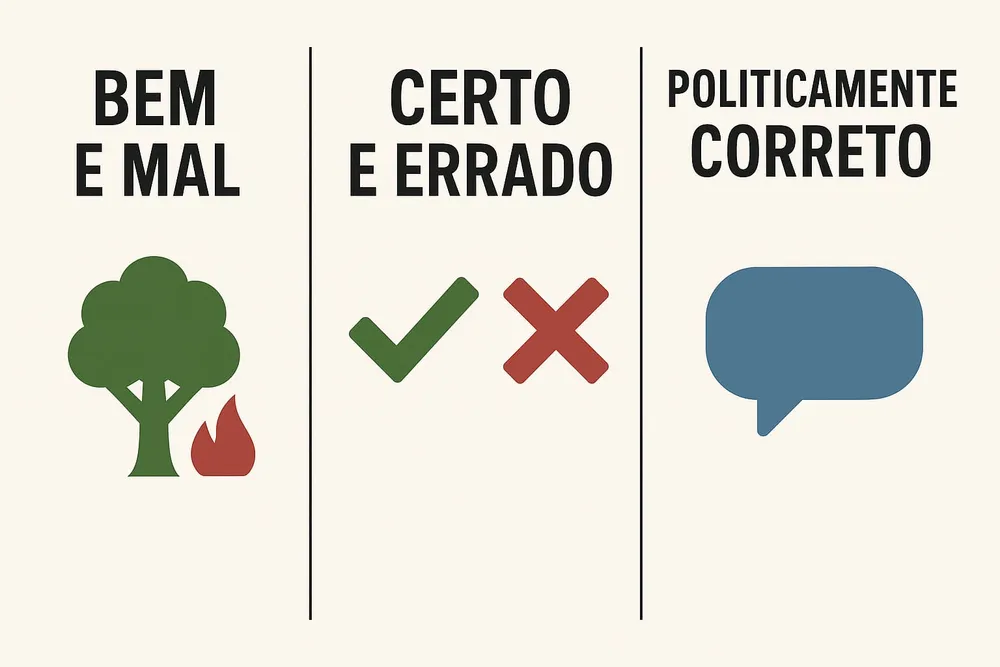
We live in a world where words carry different weights and meanings depending on the culture, the era and even the intention of the one who uses them. Terms like good and evil, right and wrong, and political correctness are often mixed together, but at the root, they have very different origins and meanings, especially when we look through the lens of the Scriptures.
This article seeks to clarify these differences and provoke a reflection: are we living by human morality, by God's ethics, or just by the social filter of what is accepted?
💭 Between the lines: As I write this, I realize that these questions did not arise only in the realm of ideas. They came from years, decades, of stumbling, regrets, new beginnings. I do not speak as a scholar: I speak as someone who had to be broken and remade many times before beginning to see these distinctions.
The Difference between Morality and Ethics
In philosophy, morality is the set of norms and values of a society, which defines what is right or wrong within a cultural context. Ethics, on the other hand, seeks a deeper level: what is good or bad, that which touches the essence of the human being, beyond social conventions.
In the Bible, we see this distinction clearly: the Mosaic Law regulated behavior (morality), but Jesus' new commandment points to the heart (divine ethics).
💭 Between the lines: I have always known, rationally, that morality and ethics were not the same thing. But it was only by living, making mistakes, hurting and being hurt that I began to truly understand. It is not just a matter of concepts: it is a personal confrontation.
What Good and Evil Are in the Scriptures
The biblical account does not focus on “right and wrong” as human categories, but on life and death, light and darkness, good and evil, spiritual dimensions that transcend codes of conduct.
Good is not simply doing what seems right; it is living according to the nature of God. Evil is not just making mistakes; it is being separated from Him.
Adam and Eve, in Eden, did not fall because they did something “wrong” according to a moral rule, but because they broke a relationship of trust with God. The forbidden fruit was from the knowledge of good and evil, not to discern right and wrong, but to put themselves in God's place as judge.
💭 Between the lines: This story has always stirred me. Because, deep down, when I look at my own falls, I realize that they were not born of ignorance of rules, but of the pride of wanting to be judge, of deciding for myself what was good for me.
How Right and Wrong Distort This
When we reduce the spiritual life to a list of right and wrong things, we fall into the trap of the Pharisees: a moralistic religion that measures the outside and forgets the heart.
Jesus directly confronted this posture, showing that human right and wrong save no one, because “even the tax collectors do that”.
Besides, human rules change. What was right yesterday may be wrong today, depending on the culture. God's good and evil, however, are unchanging, because they are born from His own nature.
💭 Between the lines: How many times I myself fell into this! How many times I measured people, situations, and myself, by human standards, while ignoring what God was really trying to work on in the heart.
The Impact of Political Correctness Today
Political correctness is not about true ethics or deep morality: it only takes care of appearance, of socially accepted language, of public image.
And, far from easing tensions, it often makes them worse. It does not bring people closer; it separates. It turns everything into a field of symbolic dispute, creates polarized groups, arms people with banners of offense and social trenches.
In the end, it does not heal injustices; it masks conflicts and even feeds them, because the root remains intact: the untransformed human heart.
💭 Between the lines: I see this every day: people who defend “right” causes, but who live in inner war; groups that cry out for justice, but without peace. And I myself am sometimes tempted to line up on one of these sides, forgetting that the real work is in the heart, not on the social battlefield.
Self-Criticism: The Risk We All Run
Even we, who speak against moralism or political correctness, can fall into similar traps.
We may think we are speaking the truth, when in fact we are only seeking to be right.
We may feel we are “on the right side”, when, deep down, we are only creating another field of polarization.
As Paul said: “Let anyone who thinks he is standing take heed lest he fall.”
💭 Between the lines: I confess, without shame: at 67 years old, I still struggle against the tendency to make gross mistakes. And if I have not made them, it is because the Holy Spirit kept me from them. It is not my merit. If I am here, it is because He has sustained me, day after day.
Personal Testimony: A Painful and Liberating Process
For a long time, I knew, from biblical understanding, that those who do evil do not know what they are doing. Jesus himself prayed on the cross: “Father, forgive them, for they do not know what they do.”
But recently, God dealt with this in a very personal way with me. No longer looking at others, but at myself.
I saw myself doing evil, yes, I, who knew what was good and right, was still capable of hurting, of failing, of acting against what I myself defended. It was a painful process, because there is nothing harder than being confronted by the Holy Spirit about what we hide even from ourselves.
But it was also liberating, because only those who face their own misery honestly can experience the grace that forgives, that cleanses, that restores.
And today I can say, without shame: if I am standing, it is not because I am strong or because I was transformed once and for all, it is because He, day after day, has sustained me and continues to transform me.