Hell: what the Bible really reveals
Hell is described as a physical place, of literal fire, created by God to punish the wicked eternally. Is it really so?
Airton Humber · 26/06/25 · 7 min de leitura
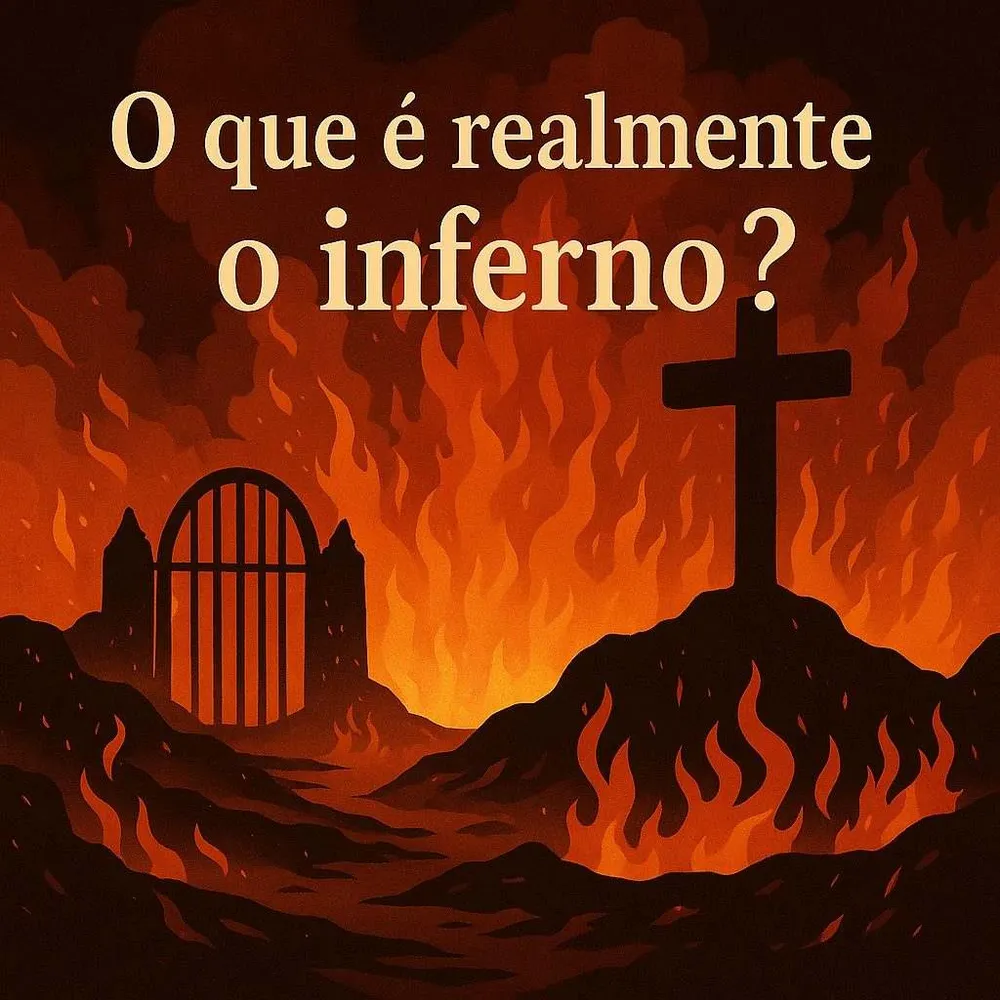
Hell, Eternal Life and the Age to Come: what they say, what people think, what the Bible reveals
1. Hell
What religious tradition says
For centuries, preachers, artists and religious leaders have described hell as a physical place, of literal fire, created by God to punish the wicked eternally. There, according to this tradition, Satan reigns as lord of darkness, tormenting souls with pitchforks, screams and flames. This image gained strength in the Middle Ages, with works like Dante's "The Divine Comedy," and was reinforced in sermons that used fear as an instrument of control. The result? A God who seems more vengeful than loving, and an eternity based on terror.
What people generally think
Many people see hell as:
A threat for those who "don't behave."
A punishment reserved for the worst.
A question without an answer ("does it really exist?").
A caricature: the devil with horns, fire, chains, etc.
Even inside the churches, there are those who live afraid of hell without ever having understood what the Bible really says. Others dismiss it as a myth, because they cannot believe in a God who punishes forever.
What the Bible reveals
Here is the turn.
When we read the Scriptures with the eyes of the Spirit, we realize that hell is not a geographical place, but a spiritual state, the absence of God.
It is not a punishment designed in advance, but the consequence of a life lived far from the Source.
The Bible uses words like:
-
Sheol (Hebrew), the world of the dead, with no direct reference to punishment.
-
Hades (Greek), equivalent to Sheol, also as a place of waiting.
-
Gehenna, a real valley on the outskirts of Jerusalem, used as a garbage dump and as a metaphor for destruction.
-
Lake of fire, a figure used in Revelation to symbolize final judgment and total separation from God.
None of these words supports the traditional image we inherited.
On the contrary, the central message of the Scriptures is clear: separation from God is already happening, and that is what we call hell.
See what the Bible says:
"We know that we are of God, and that the whole world is under the power of the Evil One."(1 John 5:19)
Hell, therefore, is not in an "age to come," it already acts in this world.
It is the fallen system, dominated by darkness, of which we are a part before being set free by the Spirit.
From the beginning, God saw that the human inclination, far from Him, was self-destructive:
"Every imagination of the thoughts of his heart was only evil continually."(Genesis 6:5)
This is the world that Paul calls "the present evil age", not because it will become so, but because it already is.
"Our struggle is not against human beings, but against the powers and authorities, against the rulers of this world of darkness…"(Ephesians 6:12)
But there is a powerful contrast:
"He delivered us from the dominion of darkness and transferred us into the Kingdom of the Son of his love."(Colossians 1:13)
This verse sums up the gospel in an impressive way.
Note: it does not say that He will set us free, nor that one day He will transfer us. It is in the past.
The work has already been done. There is already a Kingdom. There is already a deliverance.
The word "dominion" (or "empire," depending on the translation) carries the idea of a tyrannical, invisible government that imprisons minds, cultures, systems and hearts.
It is this "dominion of darkness" that governs the world, not a place with fire, but a spiritual atmosphere where God is absent and the ego reigns.
And "transferred us" does not mean changing place physically.
It means changing spiritual reality, leaving slavery and entering the freedom of the children.
Whoever is in Christ has already been pulled out of that darkness and placed in a new condition: the Kingdom of the Son, where love reigns, and not fear.
This verse is not speaking of heaven after death.
It is speaking of what happens when the Spirit comes to dwell in us.
This is the good news.
Hell is not inevitable. Condemnation is not a sentence, but a condition, one from which we can leave.
And deliverance does not come after death, but when the Spirit enters.
Who set us free? God the Father Himself.
This verse is part of a passage where Paul is giving thanks to the Father, and says in so many words: it was He, the Father, who rescued us from the dominion of darkness.
And how did He do it?
By giving us the Son and, through Him, giving us the Spirit.
It is not a symbolic deliverance, nor a future one. It is a spiritual reality that has already begun in Christ and becomes concrete when we receive the Holy Spirit.
The dominion of darkness is the invisible system that rules this world, estranged from God.
The Kingdom of the Son is the spiritual space where love, light and communion with the Father reign, already accessible to whoever has the Spirit.
Therefore, Colossians 1:13 does not speak of a geographical change, but of a transfer of spiritual government.
God did not take us out of a place, He took us out of a condition, and brought us into a new reality: the Kingdom where Christ reigns.
Jesus explained this simply:
"This is the judgment: the light has come into the world, but people loved darkness more than the light…"(John 3:19)
In other words: judgment is not a future day, it is the moment when someone chooses the darkness, even in the face of the light.
Summary
Hell is not a destination, it is a distance.
It is not what happens after death, it is what happens far from God.
It is not punishment, it is the consequence of the absence of the Spirit.
And it begins now.
2. Eternal Life
What religious tradition says
Tradition taught that eternal life is a reward for after death, granted to whoever "accepted Jesus" and lived correctly. In this model, eternity looks like a prize conditioned on earthly performance and faithfulness to religion.
What people generally think
Eternal life is living in heaven after death.
A place without pain and suffering.
Something that depends on the right religion.
Or, for some, a comforting illusion in the face of death.
What the Bible reveals
Jesus declared clearly:
"This is eternal life: that they know you, the only true God, and Jesus Christ, whom you sent." (John 17:3)
Eternal life is not just living forever, but knowing the Father.
It begins when the Spirit reveals God to the human heart. It is a quality of life in communion with God, here and now, and not just a future hope.
This changes everything.
Eternal life is not living forever. It is knowing the Father.
It is not infinite time, it is a quality of existence: communion with God.
That is why Jesus speaks of it in the present, as something that is already possible.
He is not speaking of a post-death future, but of a reality that begins the moment the Spirit reveals the Father to the human heart.
Without the Spirit, everything is religion.
With the Spirit, everything is revelation.
Eternal life is what happens when the Holy Spirit dwells in us and we begin to live in relationship with the Father, not with a system of rules, but with a living presence.
This explains why so many who speak of "heaven" still live in darkness.
And why some, even in the midst of pain, shine with the peace of those who have already known eternity.
Eternal life does not begin when the body dies.
It begins when the heart awakens.
Summary
Eternal life does not begin after death, it begins when we know the Father.
It is not endless time, but a life with God.
And only the Spirit can reveal this life.
3. The Age to Come
What religious tradition says
"The age to come," that which is yet to come, is usually associated with the afterlife, with the "beyond," with the end of time.
For tradition, the age to come is what comes after life:
The final judgment.
The definitive separation between the saved and the lost.
The arrival in heaven or the condemnation to hell.
This imagery has been reinforced with literal interpretations of Revelation, eschatological speculation and even calendars of the "end of the world."
The result is a futurophobic Christianity, anxious or paralyzed, more concerned with what comes after death than with what the Spirit can do today.
What people generally think
The age to come is the "day of judgment."
It is when God "will set everything right."
It is an event that no one knows when it will be, so the best thing is to secure your passport to heaven.
Many live between fear and hope, but always projecting everything onto the afterward, while the now is being lost.
What the Bible reveals
Jesus surprises when He speaks of the age to come.
He says something that almost no one noticed:
"Some of those standing here will by no means taste death before they see the Kingdom of God coming with power."(Mark 9:1)
This is not a future eschatological promise.
It is a prophecy that was fulfilled a few years later, in Acts 2, when the Holy Spirit was poured out and the Kingdom began to manifest in power.
The age to come, therefore, is not the end of time. It is the beginning of a new era: the era of the Spirit.
Paul understood this clearly.
He did not preach a Christ merely "crucified for us," but a Christ formed in us.
Not an age to come that begins after the judgment, but a Kingdom that is revealed now.
"Christ in you, the hope of glory."(Colossians 1:27)
"My children, for whom I again suffer birth pains, until Christ is formed in you."(Galatians 4:19)
The true age to come is not a future event, but a spiritual process:
The Kingdom coming upon us.
The Spirit being received.
Christ being formed.
The glory being revealed in us, and not just before us.
That is why judgment, heaven and hell are not tied only to the afterlife, but to the state of the soul here and now.
The Spirit is the key to everything.
Summary
The age to come is not the end of the world, it is the beginning of a new life in the Spirit.
It is not a calendar, it is a presence.
It is not for later, it is for now.
The Kingdom has already come, the Spirit has already been given.
What remains is to know: are we living this age to come?
Conclusion
Hell, eternal life and the age to come have stopped being distant mysteries.
When the Spirit reveals, everything changes.
Hell is not a place created by God to punish.
It is the state of one who lives far from Him.
Even while breathing.
Eternal life is not the prize of the good.
It is the intimate knowledge of the Father.
Here. Now.
The age to come is not a day on the calendar.
It is an era that has already begun.
It is the Kingdom in us.
It is Christ being formed.
Christ did not call us to wait for heaven.
He called us to live in the Spirit.
Because heaven is presence.
And hell, absence.
And it is not the place that defines eternity,
it is the presence or absence of the Spirit.