The Ignominy
The cross was more exposed than we tell it. Over time, man covered what God revealed, and that changed the way we understand everything.
Airton Humber · 08/04/26 · 2 min de leitura
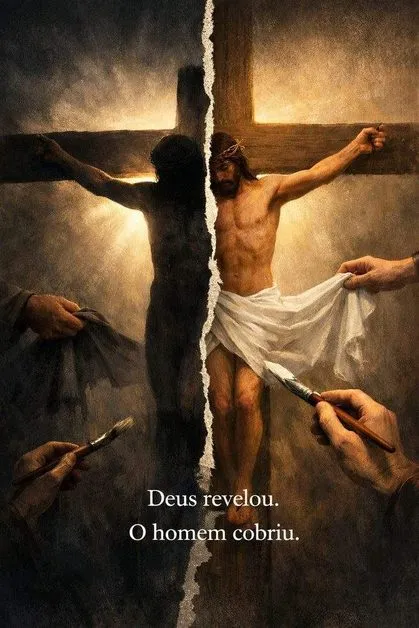
God revealed. Man covered.
There is something about the cross that is almost never said.
Not because it is hidden in the Bible.
But because, over time, it was softened.
Roman crucifixion was not just a form of execution.
It was a form of exposure.
The condemned man was:
- stripped
- lifted up publicly
- placed in a position of total vulnerability
There was no dignity preserved.
There was no covering.
It was ignominy in its rawest form.
And Jesus went through this.
But when we look at the images…
something stands out.
Almost all of them show a cloth covering his body.
A seemingly small detail.
But one that reveals something much bigger.
What Scripture shows… and what we did with it
The gospels record that his garments were divided.
Nothing indicates that any covering was left.
On the contrary.
Everything points to complete exposure.
But over the centuries, man began to cover.
Not out of malice.
But out of an inability to face it.
You shall not make for yourself an image
The second commandment says:
“You shall not make for yourself a carved image…”
This is not only about external idolatry.
It is about something deeper:
👉 the human tendency to represent God in our own way
To make him more acceptable.
More understandable.
Less confrontational.
Adding… or protecting?
In Revelation it is written:
“If anyone adds anything…”
“And if anyone takes away words…”
This is not a religious threat.
It is a warning.
Because when we add…
👉 we change the message
And when we take away…
👉 we also change it
What we did with the cross
Without realizing it, by covering the nakedness of Jesus, we did something symbolic:
👉 we reduced the ignominy of the cross
We turned something absolutely exposed…
into something more comfortable to contemplate.
And it did not stay only in art
This movement did not happen only in the depictions of the cross.
In the Sistine Chapel, in the work The Last Judgment, Michelangelo painted human bodies exposed, without covering, as an expression of the reality of man before God.
The reaction came later.
Parts of the painting were covered.
Not because they were wrong.
But because they were hard to face.
The pattern repeats.
Man covers what confronts him.
This movement continues.
Even today.
We still cover.
We cover when:
- we soften the gospel
- we avoid confrontation
- we keep up a spiritual appearance
- we speak of God without allowing him to reveal us
We create a more acceptable version.
More controllable.
The result of this
When the cross is covered…
it loses its impact.
Because the cross did not come to:
- decorate
- merely inspire
- comfort superficially
It came to bring man to the end of himself.
Without exposure…
there is no truth.
Without truth…
there is no transformation.
What God does today
If man keeps covering…
God keeps revealing.
But now no longer on the cross.
👉 in us.
Because the same cross that exposed everything…
also opened a way:
not for us to live exposed to judgment,
but free from the need to hide.
And the garments?
If man covered…
God also speaks of garments.
But they are not the same.
Man's garments hide.
God's garments reveal.
In Revelation, white garments are given.
Not to protect an image.
But because there is nothing left to hide.
The cross exposes.
Grace clothes.
Conclusion
Man covers.
God clothes.
And the cross…
as it really was
keeps on revealing.