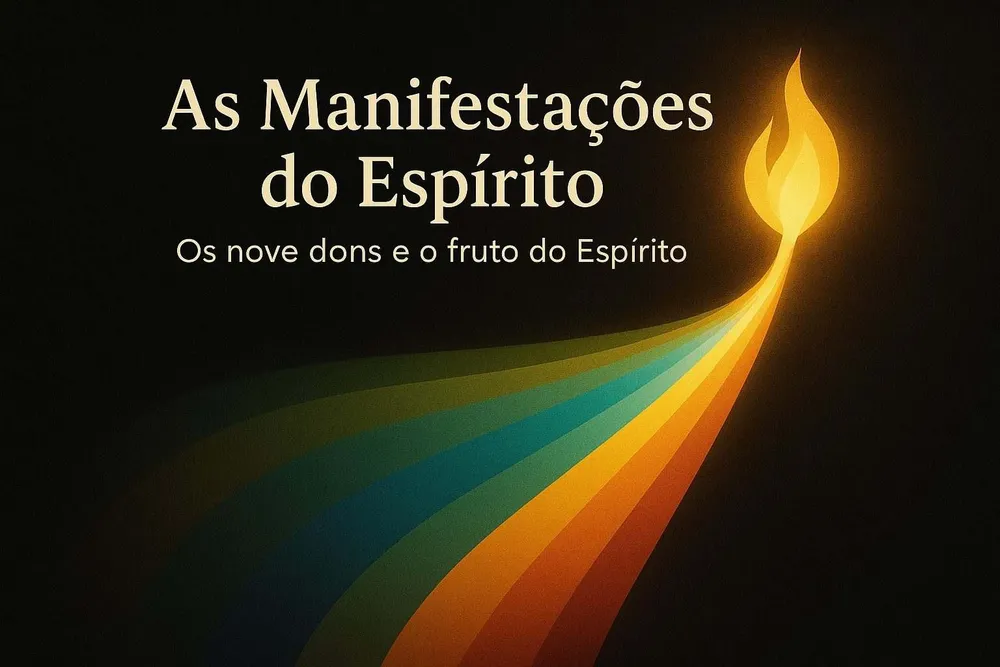
The manifestations of the Spirit
The manifestations of the Spirit in us are never self-promotion, but service. God distributes power so that Christ may be manifested collectively.
Airton Humber · 12/10/25 · 5 min de leitura
1. The purpose of the manifestations of the Spirit: the common good
The manifestations of the Spirit in us are never for self-promotion, but for service. God does not distribute power to create spiritual hierarchies, but so that Christ may be manifested collectively in the body.
The first revelation is that gifts are not for the one who receives them, but for those around them.
“To each one is given the manifestation of the Spirit, for the common good.” (1 Cor 12:7).
This “common good” is not only the well-being of the community, but the spiritual growth of the whole body, where each member contributes what the Spirit works in them.
Thus, the gift stops being a sign of status and becomes an expression of love in action, the energy of the Kingdom flowing through ordinary people.
2. Diversity: to each one is given
Paul does not say “to some”, but “to each one”.
There is no Christian without a manifestation of the Spirit; what exists is a Christian who has not yet noticed what the Spirit wants to manifest in them.
This diversity reflects the nature of God himself, who is one in essence, but manifold in expression. Wisdom, knowledge, faith, healing, prophecy, discernment… all of these are different faces of the same light.
Just as sunlight, passing through a prism, reveals itself in many colors, the Spirit, passing through each human being, reveals himself in different ways.
3. The origin: by the same Spirit
Paul repeats it several times: “by the same Spirit”, “by the one Spirit”, “by the one and the same Spirit”.
He insists on this so that there is no confusion: these are not gifts of people, they are manifestations of God in them.
The mistake of institutional religion was to turn spiritual gifts into careers and offices. But when the Spirit is the origin, there is no competition. The same Spirit who inspires one to heal, inspires another to discern, another to teach, another to pray with power. All of them flow from the same source.
4. Sovereignty, as he wills
Perhaps this is the hardest point for the human ego.
The Spirit does not obey the will of man: He blows where He wills (John 3:8).
He chooses who, when and how to manifest Himself.
This sovereignty guarantees that no one can manipulate the Spirit, but also that no one is excluded.
He distributes not according to merit, but according to purpose.
And for that very reason, the Spirit is free, and where He is, there is freedom.
5. The Spirit acting in the ordinary
The Spirit no longer dwells in temples of stone, but in people.
For that reason, spiritual manifestations are not limited to services or religious meetings; they happen in the flow of life: at work, in conversations, in decisions, in daily encounters.
The natural man separates the “sacred” from the “profane”, but the spiritual man lives in constant communion.
And it is in this state of communion that gifts become spontaneous expressions of God's love.
6. The nine manifestations of the Spirit (1 Cor 12:8-10)
1️⃣ Word of wisdom, the mind of Christ in action.
2️⃣ Word of knowledge, the discernment of the invisible.
3️⃣ Faith, the gaze that sees the invisible.
4️⃣ Gifts of healing, the touch of love.
5️⃣ Working of miracles, the impossible becoming natural.
6️⃣ Prophecy, the living voice of God.
7️⃣ Discernment of spirits, the pure gaze.
8️⃣ Different kinds of tongues, the Spirit praying in us.
9️⃣ Interpretation of tongues, the translation of God's heart.
These gifts are the life of the Spirit flowing outward. They are given to “each one”, not for personal prominence, but so that Christ may be seen in the body, in its many expressions.
7. The fruit of the Spirit (Gal 5:22-23)
“But the fruit of the Spirit is: love, joy, peace, patience, kindness, goodness, faithfulness, gentleness and self-control.” (Gal 5:22-23)
The apostle uses “fruit” in the singular, and that is revealing.
The Spirit does not produce many different fruits, but a single fruit with nine expressions, just as one light contains all the colors or one cluster contains many grapes.
It is Christ formed in us, manifesting Himself in a complete and harmonious way.
1️⃣ Love, the essence of everything; the root and flavor of all the fruit.
2️⃣ Joy, the reflection of love at rest, the inner contentment of the Spirit.
3️⃣ Peace, love reigning, bringing stability to the soul.
4️⃣ Patience, love that endures time, trusting in God's working.
5️⃣ Kindness, love becoming gentle in dealing with others.
6️⃣ Goodness, love acting with generosity and truth.
7️⃣ Faithfulness, love remaining firm, even when no one is watching.
8️⃣ Gentleness, love surrendered, strength under control.
9️⃣ Self-control, love governing all the other expressions.
The fruit of the Spirit is Christ in us, and each of these expressions is a face of the same divine nature.
When it matures in us, it reveals the character of God himself.
8. The correspondence between gifts and fruit
Gift (1 Cor 12), Fruit (Gal 5), Spiritual connection
Word of wisdom, Love, Love is the wisdom that acts rightly.
Word of knowledge, Joy, Joy comes from the revelation of what is true.
Faith, Peace, Faith is the trust that generates inner peace.
Gifts of healing, Patience, Healing demands time, compassion and perseverance.
Working of miracles, Kindness, The miracle here is to perceive divine goodness manifesting itself in me.
Prophecy, Goodness, To speak for God is to express His goodness and truth to the other.
Discernment of spirits, Faithfulness, Discernment is born of faithfulness to the light.
Different kinds of tongues, Gentleness, True spiritual speaking comes from a gentle spirit.
Interpretation of tongues, Self-control, Submission to the Spirit requires self-control and sobriety.
The gifts and the fruit do not compete, they complete each other. The gifts are the acting of Christ; the fruit is the being of Christ. When the Spirit matures in us, power flows with purity.
9. Love: the link between being and acting
Paul places chapter 13, love, between chapters 12 and 14, as a bridge between power and maturity.
It is love that gives meaning to everything.
Without it, prophecies become noise, tongues become confusion, and the gift loses direction.
“Though I speak with the tongues of men and of angels, if I have not love, I am nothing.” (1 Cor 13:1)
Love is the central axis:
It is what moves the gifts.
It is what matures the fruit.
It is what reveals the living Christ in us.
10. Conclusion: Christ formed and manifested
The fruit reveals Christ being formed in us; the gifts reveal Christ working through us.
And it is only when He is formed that the working becomes pure.
The world needs to see the power of the Spirit, but it also needs to feel the beauty of the Spirit.
The fruit shows earth becoming heaven. The gift shows heaven touching earth.
And love is the Spirit uniting the two in perfect harmony.