Who Is Right?
The question “Who is right?” is very small. The truth does not fit on one side only. Maturity does not seek to win: it seeks to understand.
Airton Humber · 14/11/25 · 2 min de leitura
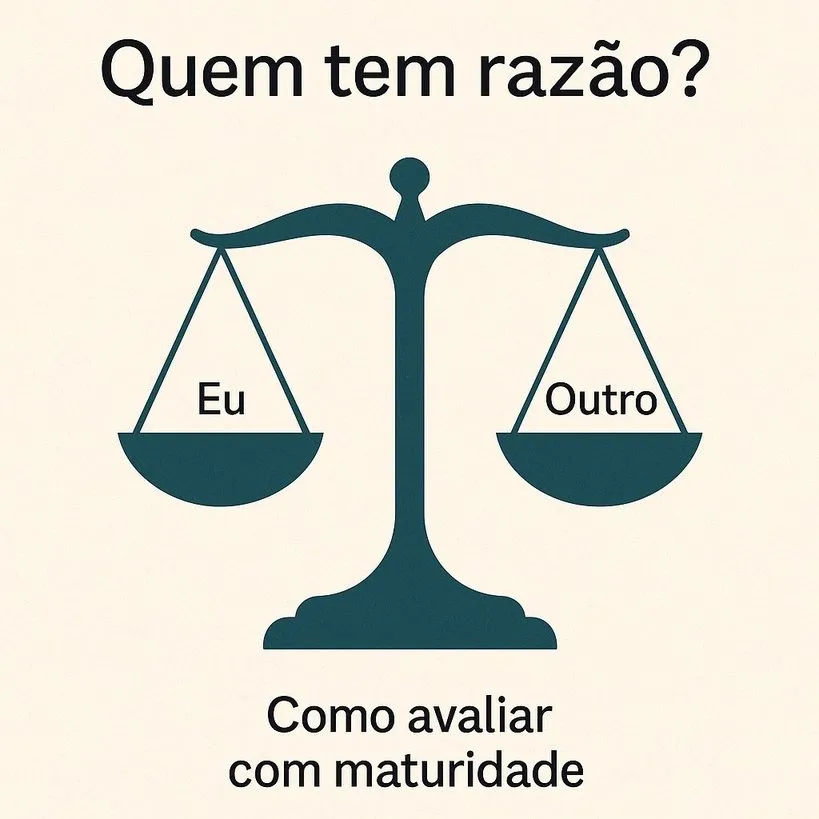
We live in a world where people believe that being right is an exclusive territory.
>If I am right, the other person's reason disappears.
>If I am correct, the other is automatically wrong.
>If something is good for me, whoever thinks differently is in the wrong.
This childish logic has destroyed relationships, churches, friendships and even companies.
But human reality is much more complex, much deeper and much more beautiful than this simplistic dualism.
Before analyzing any situation, conflict, divergence or disagreement, we need to undo six misconceptions that distort perception:
1. The misconception of the exclusivity of being right
It is not true that only one person can be right. Many times, each person sees a legitimate aspect of the same reality. The truth is not a point; it is a space.
2. The misconception of automatic right x wrong
Most conflicts are not moral. It is not right against wrong. They are two different perspectives and two true sufferings coexisting.
3. The misconception of demonization
Disagreeing is not doing evil.
Difference is not malice.
Perspective is not character.
4. The misconception of justification as being right
Justification is defense.
Being right is inner truth.
So confusing the two produces blindness and arrogance.
5. The misconception of pride as the center
Pride turns disagreement into a personal attack.
While pride rules, there is no clear perception.
6. The misconception of ignoring mercy and truth
Truth sees the fact.
Mercy sees the person.
Maturity integrates the two.
The seven dimensions of maturity in evaluating situations
After removing the misconceptions, we can finally analyze any situation in depth.
And this analysis is organized in seven dimensions, from the most external to the most internal:
1. Each party's reasons
Understanding the why before the what.
Criterion of maturity: seeing the heart before judging the behavior.
2. Legality
What the law permits or forbids.
Criterion of maturity: the law defines the minimum of what is just, not the maximum of what is good.
3. Morality: right/wrong
Rules, customs and social expectations.
Criterion of maturity: morality measures actions, not intentions.
4. Ethics: good/evil
Intentions, integrity, true motivation.
Criterion of maturity: good is born from a true heart, not only from correct behavior.
5. Contentment
Practical peace in the face of reality.
Criterion of maturity: contentment is born from surrender, not from control.
6. Happiness
An emotional state conditioned on external circumstances.
Criterion of maturity: happiness is legitimate, but fragile.
7. Blessedness
Deep, unshakable peace, independent of circumstances.
Criterion of maturity: blessedness is the Spirit within us governing the world outside.
Conclusion
The question “Who is right?” is very small.
Because the truth does not fit on one side only.
Maturity does not seek to win, it seeks to understand.
Being right is not on one pan of the scale.
But in the capacity to see the other without losing yourself.
When this happens, it does not matter who wins the argument.
What matters is who conquers himself.