Becoming a Blessing
Have you noticed that God promised Abraham that he would be a blessing? The gospel calls us to overflow, and not only to receive.
Airton Humber · 22/06/26 · 6 min de leitura
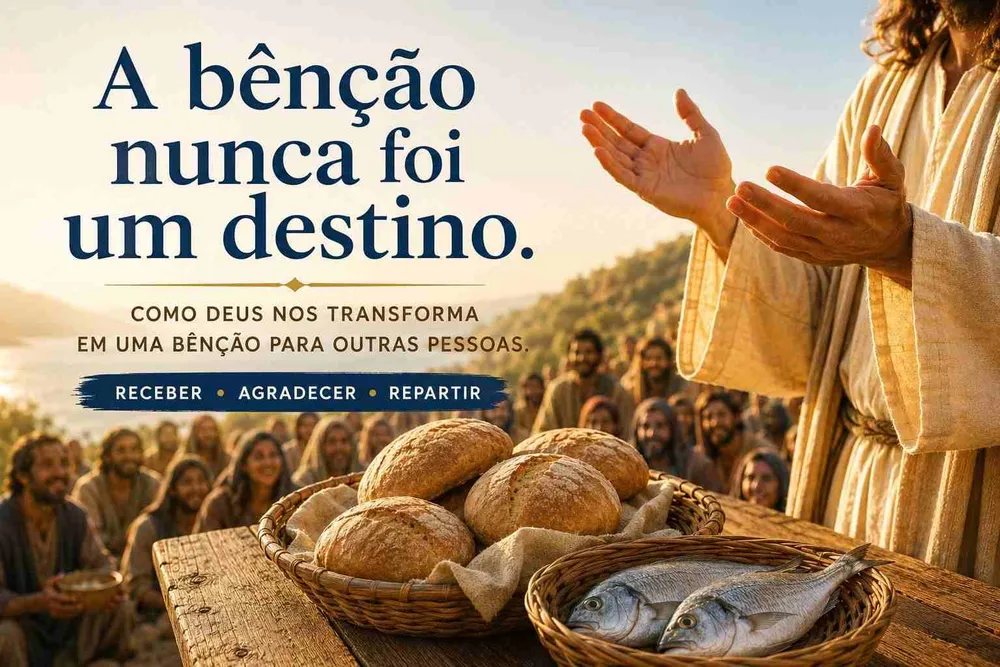
The blessing was never a destination.
It was always a flow.
Perhaps one of the greatest shifts in perspective that the gospel proposes to us is this one.
For a long time we learned to seek blessings.
We pray for blessings.
We wait for blessings.
We give thanks for the blessings received.
But from the beginning, God seemed to have a greater purpose.
When he called Abraham, he did not promise only that he would be blessed.
He promised that he would become a blessing.
Perhaps this small difference completely changes the way we see our walk with God.
What does it mean to bless?
There is an expression that is very common among us:
"God bless you."
But have we ever stopped to ask what it really means to bless?
In the Bible, blessing is not only receiving something from God.
It is tied to the life that God communicates and that overflows to other people.
God did not call us only to seek blessings, but to become a blessing.
Abraham: blessed to bless
So it was with Abraham.
"I will make you into a great nation, and I will bless you. I will make your name great, and you will be a blessing."Genesis 12:2
Notice the order.
First God blesses.
Then the man becomes a blessing.
The destination of the blessing was never to stay with us.
The blessing was always meant to pass through us.
The choice before us
In Deuteronomy, Moses sets a choice before the people:
"Pay attention! Today I am setting before you the blessing and the curse."Deuteronomy 11:26
The blessing appears as a path.
Not only as something one receives, but as a reality one enters, remains in and lives.
The search we learned
Perhaps, without realizing it, we have inverted this logic.
We learned to seek blessings.
To ask for blessings.
To wait for blessings.
As if life with God were a constant search for something we still lack.
We learned to seek the blessing, when God wants to turn us into a blessing.
But Jesus leads our eyes to another place.
In the Sermon on the Mount, he says:
"Your Father knows what you need before you ask him."Matthew 6:8
And, further on, he adds:
"For the pagans run after all these things; but your heavenly Father knows that you need them."Matthew 6:32
Food.
Drink.
Clothes.
Jesus does not despise these needs.
But he shows that living by running after them is the logic of those who do not yet know the Father.
That is why he completely changes the focus:
"But seek first the Kingdom of God and his righteousness, and all these things will be added to you."Matthew 6:33
Do not seek the blessings first.
Seek the Kingdom.
The rest will be added.
The son who did not notice
Perhaps no one illustrates this mistake better than the older son in the parable told by Jesus.
He complained:
"You never gave me even a young goat so I could celebrate with my friends."Luke 15:29
Then he heard an extraordinary answer from his father:
"My son, you are always with me, and everything I have is yours."Luke 15:31
The problem was never the lack of a young goat.
It was the inability to see what he had already received.
No one lives as a blessing while believing that the blessing is still missing.
We have already been blessed
Paul makes a statement that completely changes our perspective:
"Blessed be the God and Father of our Lord Jesus Christ, who has blessed us with every spiritual blessing in the heavenly places in Christ."Ephesians 1:3
Paul does not say:
"God will bless us."
He says:
"God has blessed us."
And, in Galatians, he explains that the blessing promised to Abraham reached all nations through Christ:
"This was so that in Christ Jesus the blessing of Abraham might come to the Gentiles also, so that we might receive the promise of the Spirit through faith."Galatians 3:14
The blessing culminates in the gift of the Spirit.
Perhaps the greatest blessing is not what God gives us.
Perhaps it is God himself dwelling in us by his Spirit.
Jesus: receive, give thanks and share
Jesus showed us this path in a practical way.
Before a hungry crowd, there were only a few loaves and fish.
Humanly speaking, it was little.
But Jesus did not begin by lamenting the scarcity.
He took what was in his hands.
He gave thanks to the Father.
He blessed.
And he shared.
The little became enough for everyone.
The blessing does not begin in the quantity we have, but in gratitude for what we have received.
Whoever lives looking only at what is lacking can hardly share.
Whoever recognizes what they have already received discovers that even the little can become enough in God's hands.
Perhaps this is the path of blessing:
Receive. Give thanks. Share.
Peter: what I have, I give you
This same logic appears in Peter, at the temple gate.
Before a man who was asking for alms, Peter did not pretend to have what he did not have.
He said:
"I have no silver or gold, but what I have, this I give you."Acts 3:6
Peter did not bless from what he lacked.
He blessed from what he had received.
He had no money at that moment, but he had something greater: the life of Christ working through him.
We do not bless with what we pretend to have, but with what we have truly received.
It is more blessed to give
Perhaps that is why Jesus said:
"It is a more blessed thing to give than to receive."Acts 20:35
Not because receiving is bad.
But because giving is the natural consequence of one who has discovered that they have already received.
Whoever still lives as someone in need runs after the blessing.
Whoever has discovered the Father's love becomes a blessing.
Whoever has already been blessed does not live running after the blessing.
They live sharing the blessing.
When God changed Job's fortunes
There is a detail at the end of the book of Job that often goes unnoticed.
Job had lost practically everything.
He lost his possessions.
He lost his children.
He lost his health.
And, in that condition of deep pain, his own wife said to him:
"Curse God and die."Job 2:9
His friends, instead of comforting him, insisted on accusing him, as if all that suffering could only be the consequence of some hidden sin.
Job was surrounded by pain, by accusation and by hopelessness.
Then he had an encounter with the Lord.
And the Bible records something very significant:
"The Lord changed Job's fortunes when he prayed for his friends; and the Lord gave him twice as much as he had before."Job 42:10
Notice what happened.
That man who had lost everything began to intercede for the very ones who had accused him.
While Job prayed for his friends, God was changing his fortunes.
Perhaps this is one of the deepest signs of restoration.
Not when we manage to explain our suffering.
Nor when all the circumstances have already changed.
But when our heart begins again to desire the good of those who walk with us, even of those who hurt us.
Job did not become a blessing again because his life was restored.
His life began to be restored when he became a blessing again.
Perhaps it is no accident.
The blessing was never made to stay locked up in us.
It was always made to flow.
You are salt and light
This same logic appears when Jesus speaks to his disciples:
"You are the salt of the earth."Matthew 5:13
"You are the light of the world."Matthew 5:14
Jesus did not say:
"Ask to be salt."
Nor:
"Pray to be light."
He declared a reality.
And, from it, revealed a responsibility.
The gospel does not begin by saying: "do in order to become".
It announces: "you have received; now live from what you have received".
Perhaps this is the difference between religion and the gospel.
Religion often teaches us to seek what we do not yet have.
The gospel awakens us to what we have already received in Christ.
God bless you?
So, perhaps it is worth observing a curiosity.
Have you noticed that the disciples hardly use the expression "God bless you" in the New Testament?
The letters speak constantly of grace, peace, mercy, love and fellowship.
Not because the blessing had ceased to exist.
But because, in Christ, it had already been granted.
Perhaps the question is no longer:
"How can I be blessed?"
But:
"How can I become a blessing?"
The greatest blessing God can grant someone is perhaps to turn them into a blessing for others.
The gospel does not invite us to live searching for blessings.
It invites us to live being a blessing.
The blessing was never made to be stored up.
It was made to flow.