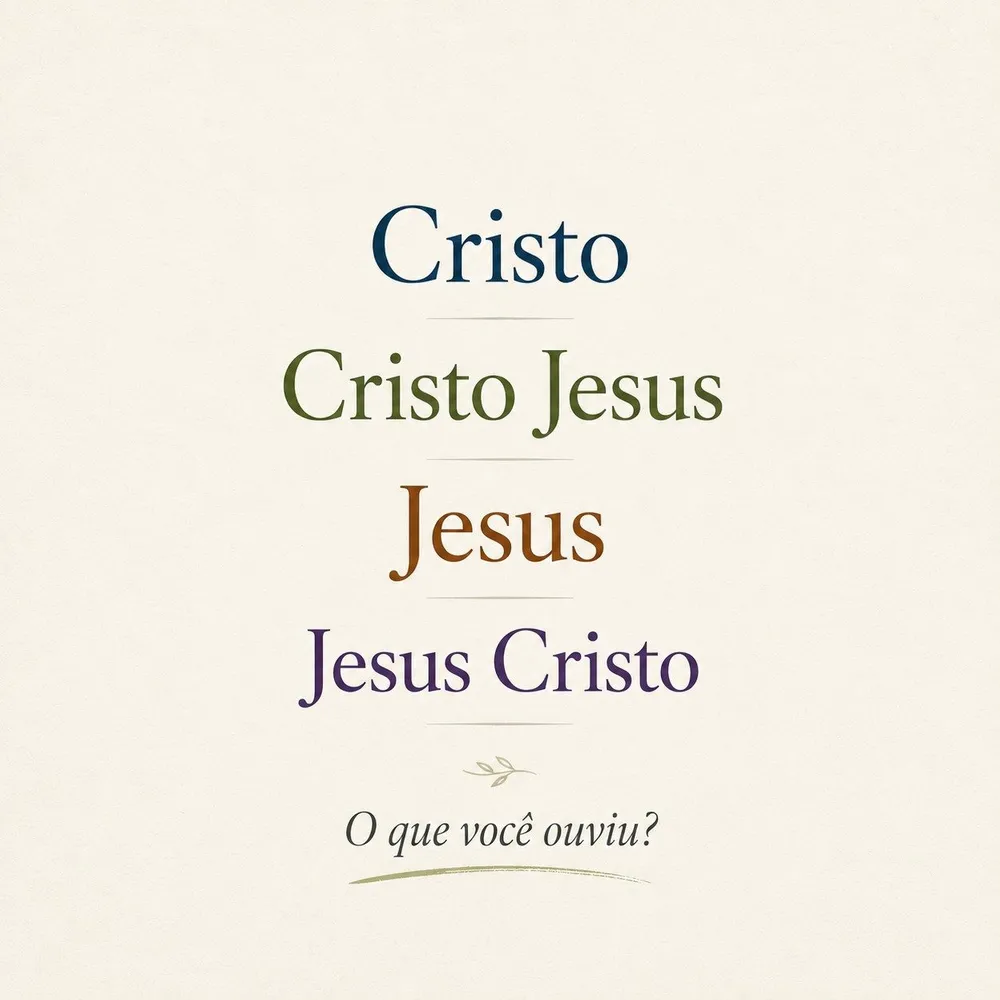
Christ, Christ Jesus, Jesus, Jesus Christ
In Philippians 2, Paul writes Christ, Christ Jesus, Jesus and Jesus Christ. Are they just different ways of saying the same thing? Before explaining, let's listen.
Airton Humber · 17/08/26 · 5 min de leitura
Is Paul saying exactly the same thing when he changes the words?
Paul was a Jew, knew the Scriptures deeply and, as a Pharisee, had been educated with great strictness in the Law of the Jews.
In his letter to the Colossians, he is trying to show us a mystery that was hidden for a long time, but that God had revealed:
Christ in you, the hope of glory.
And it is in Christ that all the treasures of wisdom and knowledge are hidden.
So it may be interesting to pay attention to the words Paul chose.
Did you notice that, throughout that letter, he uses different forms?
Christ. Christ Jesus. Jesus. Jesus Christ.
Are they just different ways of saying the same thing?
Or could these words also help us understand this wonderful mystery and discover some of those treasures?
How about reading that letter again, this time paying attention to each word?
There are words we use so many times that we almost stop hearing them.
As time goes by, we may end up treating all these expressions as if they were simply different ways of saying the same thing.
Maybe they are.
But maybe it is better not to decide that so quickly.
In his letter to the Philippians, Paul also uses these words in a very interesting sequence.
Instead of starting by trying to explain what each one means, we can do something simpler:
Listen to Paul and notice when he chooses each word.
Christ
Paul begins:
“If, because we are in Christ…”
Before speaking about behavior, humility, obedience or service, he begins with a reality:
We are in Christ.
It is from there that he speaks of encouragement, consolation of love, fellowship in the Spirit, tenderness and compassion.
The starting point does not seem to be what man must be able to produce.
The starting point is:
in Christ.
Christ Jesus
A little later, Paul writes:
“Let your attitude be the same as that of Christ Jesus…”
And then an impressive movement begins.
Christ Jesus, existing in the form of God, does not cling to the condition he has.
He empties himself.
He takes the form of a servant.
He becomes like men.
He is recognized in human form.
He humbles himself.
He becomes obedient to death.
Even death on a cross.
Paul is not presenting here just an idea about humility.
He is inviting us to observe what happened to Christ Jesus.
Maybe it is better not to explain too quickly.
Jesus
Then a change happens.
Paul says:
“Therefore God exalted him to the highest place and gave him the name that is above every name…”
And he continues:
“that at the name of Jesus every knee should bow…”
After speaking of Christ Jesus, Paul now uses simply:
Jesus.
God exalted him.
God gave him the name.
And before that name every knee bows.
Jesus Christ
The sequence then arrives at a declaration:
“and every tongue confess that Jesus Christ is Lord, to the glory of God the Father.”
Now Paul does not say just Jesus.
He says:
Jesus Christ.
And he associates this expression with another word:
Lord.
All of this happens for the glory of:
God the Father.
And then… you
It would be possible to end the reading here.
But Paul goes on.
After speaking of Christ, of Christ Jesus, of Jesus and of Jesus Christ, he turns again to those who are listening to the letter.
And he says something extraordinary:
“For it is God who works in you both to will and to do, according to his good pleasure.”
The text had begun:
“because we are in Christ…”
And now we find:
“it is God who works in you…”
There is still an expression of Paul that maybe it is better just to hear:
“Christ in you, the hope of glory.”
At the beginning:
you in Christ.
Now:
Christ in you.
Maybe it is better, once again, not to explain too quickly.
Christ
↓
Christ Jesus
↓
Jesus
↓
Jesus Christ is Lord
↓
God the Father
↓
God working in you
Is it just a way of writing?
Perhaps someone will say that Paul is just varying the words.
It could be.
But before we quickly reach a conclusion, maybe it is better simply to observe.
Paul could have used the same expression throughout the passage.
But he did not.
He begins with Christ.
Then he says Christ Jesus.
Then, Jesus.
Then, Jesus Christ.
And soon after he speaks of God working in us.
Maybe these words are just different ways of referring to the same reality.
Maybe each one illuminates something that the others, alone, cannot say.
Words are necessary.
But they are limited.
Maybe it is better to listen before explaining.
The light that shines
And maybe we can listen to still other words from the Scriptures.
In the beginning, when there was darkness over the face of the deep, God said:
“Let there be light.”
And there was light.
John, speaking of the one who was in the beginning with God, writes:
“In him was life, and this life was the light of men.”
And a little later:
“The true light, which gives light to every man, was coming into the world.”
Jesus also said:
“I am the light of the world.”
But, at another moment, looking at those who were before him, he said:
“You are the light of the world.”
How can this happen?
Maybe it is better not to answer too quickly.
Paul writes to the Colossians about a mystery that was hidden for ages and generations and that has now been revealed:
“Christ in you, the hope of glory.”
And to the Ephesians he says something even more surprising:
“You were once darkness, but now you are light in the Lord.”
The same Paul takes up the image of the beginning:
“God, who said: ‘Light shall shine out of darkness,’ himself has shone in our heart.”
And then we hear:
“Awake, O sleeper, rise from the dead, and Christ will shine on you.”
Maybe it is not necessary to say much more.
Darkness does not produce light.
The one who sleeps does not produce light.
The true light gives light.
God makes the light shine.
Christ shines.
And then we return to the beginning of Philippians:
“If, because we are in Christ…”
And to the words that appear a little later:
“It is God who works in you both to will and to do.”
Listening
Maybe some things do not need to be explained too quickly.
We are used to reading the Bible looking for answers.
We try to find out what a certain passage means.
We ask what the correct interpretation is.
We argue about words.
We explain.
We talk.
But Jesus kept saying:
“He who has ears to hear, let him hear.”
Maybe we can do exactly that.
In no hurry to define Christ.
In no hurry to explain Christ Jesus.
In no hurry to determine why Paul wrote Jesus.
In no hurry to build a definition for Jesus Christ.
Just listen.
What did you hear?
Bible references:
Philippians 2:1–13
Genesis 1:1–3
John 1:1–9
John 8:12
Matthew 5:14
Colossians 1:26–27
Ephesians 5:8,14
2 Corinthians 4:6