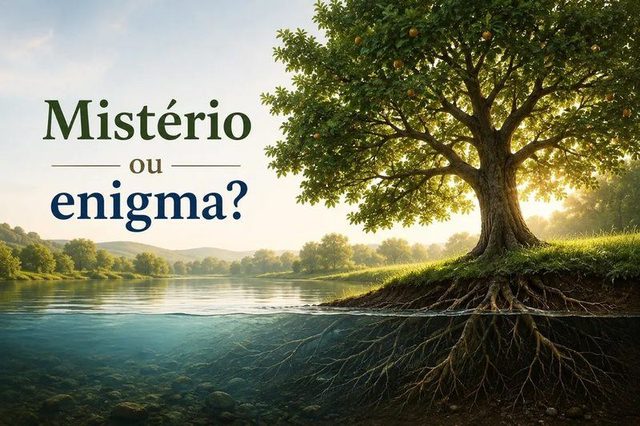
Mystery or Riddle?
A reflection from Paul's letter to the Colossians on Christ in us, the life hidden in God, and the difference between solving a riddle and receiving a mystery.
Airton Humber · 16/08/26 · 7 min de leitura
There is a sequence of verbs in Paul's letter to the Colossians that catches our attention when we read the letter without the interruptions of chapters, verses and subheadings.
Paul writes:
“As you received Christ Jesus the Lord, continue to live in him…”
Then:
“Be careful that no one enslaves you…”
Further on:
“Do not let anyone judge you…”
And again:
“Do not let anyone…”
Until we come to two apparently contradictory statements:
“You died with Christ…”
and, shortly after:
“So put to death whatever belongs to your earthly nature…”
You died.
Therefore, put to death.
How does someone who has already died still need to put to death?
The strangeness grows as we keep reading.
Paul says:
“You have taken off the old self with its practices and have put on the new…”
But a few lines later:
“Therefore, as God's chosen people, holy and loved, clothe yourselves with deep compassion, kindness, humility, gentleness and patience.”
You have already put on.
Therefore, put on.
Perhaps there is an important key here for understanding this whole part of the letter.
Paul does not begin with what we need to do.
He begins with what has happened to us in Christ.
First, we receive
Everything begins with a very simple expression:
“You received Christ Jesus the Lord…”
You did not produce.
You did not earn.
You did not reach it by merit.
You received.
And you did not simply receive a doctrine, a set of rules or a new religious knowledge.
You received Christ Jesus the Lord.
That is why Paul goes on:
“…continue to live in him, rooted and built up in him…”
The image is beautiful.
A tree does not produce the soil in which it is rooted.
It receives from that in which it is planted.
And perhaps that is why, right after, Paul gives a warning:
“Be careful that no one enslaves you…”
It does not seem to be a warning so that you obtain something you do not yet have.
It is almost the opposite.
Be careful that no one pulls you away from what you have already received.
Because Paul had just said something extraordinary about Christ:
“In him are hidden all the treasures of wisdom and knowledge.”
And shortly after he adds:
“In Christ all the fullness of the Deity lives in bodily form, and because you are in him, you have received the fullness.”
All the treasures are in him.
All the fullness is in him.
And you are in him.
So why go back to the shadows?
The hidden life
Shortly after, another word appears that deserves attention:
Hidden.
“For you died, and now your life is hidden with Christ in God.”
Before, it was the treasures of wisdom and knowledge that were
hidden in Christ.
Now it is our own life that is
hidden with Christ in God.
And Paul goes even further:
“When Christ, who is your life, is revealed…”
He does not say only that Christ gives us life.
Christ is your life.
So we have:
the treasures hidden in Christ;
our life hidden with Christ in God;
and Christ as our very life.
This recalls an ancient and surprising declaration of the prophet Isaiah:
“Truly you are a God who hides himself…”
But the God who hides himself also says:
“You will seek me and find me when you seek me with all your heart.”
Isaiah also says:
“Seek the Lord while he may be found; call on him while he is near.”
And Jesus:
“Seek, and you will find.”
Because:
“Everyone who seeks finds.”
Perhaps hidden does not mean absent.
It may mean: present, but not yet fully revealed.
Therefore, seek
And this is exactly the verb that appears in Colossians:
“Therefore, since you have been raised with Christ, seek the things that are above…”
Another apparent contradiction.
They have already received Christ.
They have already died with Christ.
They have already been raised with Christ.
Their life is hidden with Christ in God.
And now:
Seek.
It does not seem to be the search of someone looking for a distant God in order to find him.
It is the search of someone who has already received Christ and whose own life is hidden with him in God.
Perhaps that is why Jesus said:
“But seek first the Kingdom of God and his righteousness, and all these things will be added to you.”
Jesus had just spoken about food, drink and clothes.
Necessary things.
But not things that should occupy first place in the search.
Seek the Kingdom.
The other things will be added.
The tree does not eat its own fruit
Perhaps the image of the tree can help us.
The Psalm speaks of the one who is:
“like a tree planted by streams of water, which yields its fruit in season, and whose leaf does not wither.”
The tree is planted by the waters.
And then it bears fruit.
It does not run after the fruit.
It does not produce the water.
It does not manufacture life.
It receives.
And bears fruit.
Even more interesting:
The tree does not eat its own fruit.
The fruit that is born in it serves another.
This image runs through the Scriptures.
God said to Abraham:
“I will bless you […] and you will be a blessing.”
Not only:
I will bless you.
But:
You will be a blessing.
The blessing received does not end with the one who receives it.
Jesus will say that, in the Kingdom of God, the greatest is the one who serves.
And Paul preserved a saying of Jesus:
“There is more happiness in giving than in receiving.”
First we receive.
Then we give.
And perhaps that is exactly what happens with the tree.
It receives from the water.
And offers fruit.
At the end of the Scriptures, the image reaches the nations:
“The leaves of the tree are for the healing of the nations.”
Fruit to feed.
Leaves to heal.
The life received becomes life for the other.
Christ is the life
Now we can return to Paul's strange imperative:
“So put to death whatever belongs to your earthly nature…”
The order is fundamental.
Paul does not say:
Put to death so that you can die with Christ.
He says:
You died with Christ.
And then:
Therefore, put to death.
He does not say:
Put on so that you can become the new self.
First he says:
You have put on the new.
And then:
Therefore, put on.
The fact comes before the imperative.
The life comes before the fruit.
And what they are to put on is deeply directed toward the other:
compassion,
kindness,
humility,
gentleness,
patience,
forgiveness,
love.
Perhaps we are once again facing the tree.
The life is hidden in the roots.
But the fruit appears.
The hidden life is manifested
Paul had said:
“Your life is hidden with Christ in God.”
But he continues:
“When Christ, who is your life, is revealed, then you also will be revealed with him in glory.”
Hidden.
Then: manifested.
This sheds light on another expression from the same letter:
“Christ in you, the hope of glory.”
Perhaps glory is not only something we will receive one day.
There is also the idea of the manifestation of what today is hidden.
Christ in us.
Christ, our life.
And this life being manifested.
It is hard not to remember:
“The Son is the radiance of God's glory…”
Radiance is light becoming visible.
The light is manifested.
It shines.
It can be seen.
Jesus said:
“You are the light of the world.”
And:
“Let your light shine before others, so that they may see your good works and glorify your Father who is in heaven.”
Perhaps compassion, kindness, humility, gentleness, patience, forgiveness and love are
precisely some of the ways in which
the hidden life begins to become visible.
The root remains hidden.
The fruit appears.
Dwell
And then Paul arrives at a sentence that may be one of the keys to this whole reflection:
“Let the word of Christ dwell in you richly…”
The verb is surprising.
Paul does not say:
Understand fully.
He does not say:
Master intellectually.
Not even:
Explain.
He says:
Dwell.
It is the language of a home.
Something can dwell in us even when we cannot yet fully explain what is happening.
Perhaps here lies a particular difficulty for our need to understand.
We want to know how it works.
We want to establish causes, processes and consequences.
We want to draw the diagram.
But Paul presents us with something he himself calls:
mystery.
“Christ in you, the hope of glory.”
And perhaps we have often made a small mistake:
we treat the mystery as if it were a riddle.
Mystery or riddle?
A riddle exists to be solved.
As long as we have not found the answer, it remains a riddle.
When we finally discover the solution, it is over.
The riddle has ceased to exist.
But perhaps the mystery is different.
In Colossians, the mystery was revealed.
Paul tells us what it is:
Christ in you.
So it is not a secret that God refuses to tell.
The mystery was made known.
And yet it remains a mystery.
We know what Paul is announcing.
But perhaps we cannot fully explain how it happens.
How can Christ be our life?
How can we have died with Christ and still need to put to death?
How can we have been raised with Christ and still need to seek?
How can we have already put on the new and still need to put on?
How can God work in us both to will and to do and, at the same time, Paul say:
do?
How can the Spirit fight against the flesh so that we do not do what we want
and yet we are the ones who act?
Perhaps our need to understand wants what Paul does not offer us:
the complete diagram of how it works.
Paul offers us something different.
He shows us the reality.
And perhaps here is a precious distinction:
not fully understanding the mechanism does not mean not knowing the reality.
A tree does not need to understand photosynthesis to bear fruit.
It remains by the waters.
It receives.
It lives.
And, in due time, it bears fruit.
Perhaps we also cannot fully explain:
“Christ in you.”
But we can hear:
“Let the word of Christ dwell in you richly.”
We can keep seeking.
We can keep examining.
We can recognize that today we see a little more than yesterday and, perhaps tomorrow, some other scales will fall from our eyes.
It is not about giving up on understanding.
It is about understanding everything we are given to understand
without demanding that the mystery cease to be a mystery so that we can receive it.
Jesus did not say:
Understand me completely.
He said:
“Remain in me, and I will remain in you.”
Perhaps that is enough, for now.
The tree remains by the waters.
The life continues hidden in the roots.
And, in due time,
the fruit appears.