From Faith to Faith
A text under construction about Christ, Jesus, Spirit and Son of Man. An invitation to look, to contemplate, to ask and to walk from faith to faith.
Airton Humber · 21/08/26 · 11 min de leitura
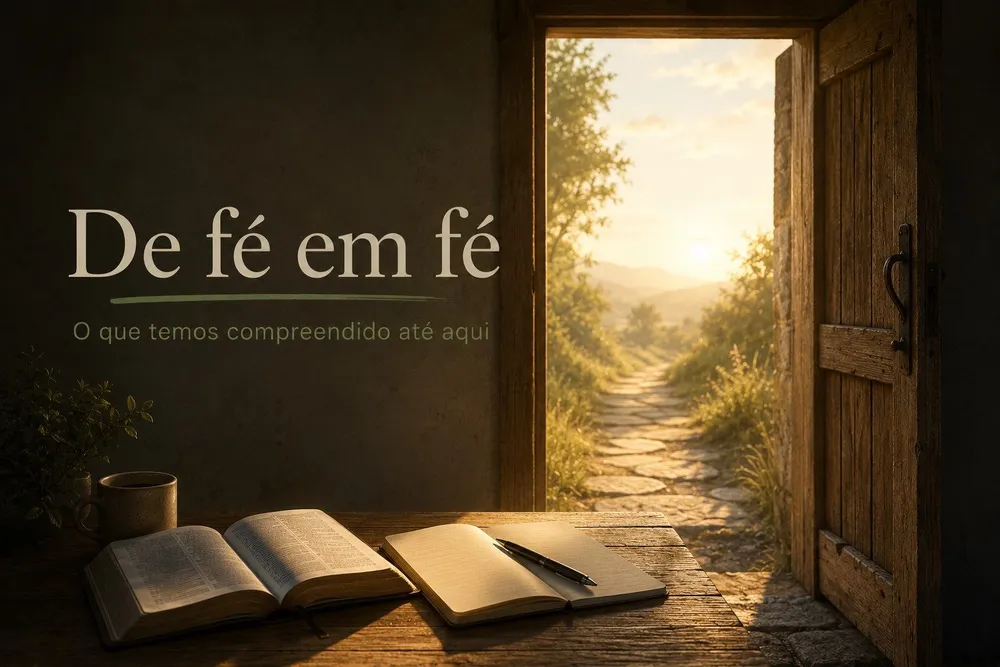
What we have understood so far
Text under construction, begun on August 21, 2026.
This is a text under construction.
And perhaps it will stay that way for a long time yet.
This reflection was born during the reading of the booklet Paul's Letter to the Colossians, in continuous reading.
As we walked through the letter, some words began to ask for a slower look:
Christ.
Christ Jesus.
Jesus.
Jesus Christ.
Spirit.
Son of Man.
And, even before we found answers to these questions, we noticed something perhaps even more important:
we do not need to understand everything to keep walking.
There are things we understand.
There are things we are beginning to understand.
And there are things we simply do not understand.
Paul was not ashamed to say:
“Now I know in part.”
Perhaps we too can recover that freedom.
The freedom to say:
“I don't know.”
We have created a strange shame about not knowing, as if we were obliged to understand everything.
I don't understand. I am ashamed to ask. I look around and everyone seems to have understood. So I stay silent, or I start defending with even more force what I already know.
Someone else may be living exactly the same thing.
And the silence of one confirms the fear of the other.
Until someone says:
“I didn't understand.”
And another answers:
“Neither did I.”
Now we can talk.
A teacher who did not understand
Nicodemus was a teacher in Israel.
He came to Jesus saying:
“We know…”
Shortly afterward he was asking:
“How can this be?”
He did not understand.
And the conversation went on.
Here too it can go on.
“I don't know” is a permitted answer.
Because, when I admit that I don't know, I can ask.
When I ask, I can listen.
And, when I listen, perhaps I begin to see.
James wrote:
“Be quick to listen, slow to speak and slow to become angry.”
And he also said something striking:
“But no one can tame the tongue.”
Perhaps maturity is not having an answer for everything.
Perhaps it also appears in the freedom to listen.
Whoever walks in darkness does not know where they are going
Jesus said:
“Whoever walks in the dark does not know where they are going.”
But he also said:
“Walk while you have the light.”
We do not need to see the whole road.
Anyone who has driven at night knows this.
The headlights light up only a small stretch.
We move on.
Another stretch appears.
We move on again.
From faith to faith.
And, if we realize we are lost, we can say:
“I don't know where I am.”
Then we can ask.
I don't know → I ask → I listen → I see → I walk.
We know in part
Paul wrote:
“Now I know in part.”
And also:
“No eye has seen, no ear has heard, no mind has imagined what God has prepared for those who love him.”
But he went on:
“But God has revealed it to us by his Spirit.”
Both things remain.
We know in part.
And:
God reveals.
No matter how far we have walked, there will always be more than our eyes have seen, our ears have heard or our hearts have been able to conceive.
That is why we walk.
Not from complete understanding to complete understanding.
From faith to faith.
Wisdom, stature and grace
Solomon received extraordinary wisdom.
He investigated. He observed. He came to know.
And he reached a painful conclusion:
“Whoever increases knowledge increases sorrow.”
Solomon also searched for joy. He tried pleasures, accomplishments, riches and knowledge. And he did not find in them anything that could last.
Then Luke records a small sentence about Jesus:
“Jesus kept growing in wisdom, stature and grace before God and men.”
Wisdom.
Stature.
Grace.
These three words deserve to stay before us.
Paul speaks of the:
“measure of the stature of the fullness of Christ.”
James says that whoever does not stumble in speech is mature, able to keep the whole body in check as well.
But shortly afterward he admits:
“But no one can tame the tongue.”
Perhaps maturity is not knowing everything or having an answer for everything.
Perhaps it also appears in the freedom to listen, to remain silent and to say:
“I don't know.”
John, for his part, contemplates the Word made flesh:
“full of grace and truth.”
And he adds:
“From his fullness we have all received grace upon grace.”
Not only wisdom.
Grace.
And then Jesus speaks of something Solomon sought and could not find in the things he tried:
“So that my joy may be in you and your joy may be complete.”
Notice again:
in you.
Not just joy.
“My joy in you.”
And Paul writes:
“The fruit of the Spirit is love, joy…”
We do not want to turn these passages into a formula that they themselves do not present.
We only want to place them before our eyes:
stature
grace
fullness
love
joy
Perhaps the answer is not simply to understand more and more.
There is also:
grace upon grace.
And there is a joy that Jesus does not tell us to go looking for:
he wants his joy to be in us.
Looking
In the desert, when someone was bitten by a serpent, they looked at the serpent that Moses had lifted up:
and lived.
Jesus recovered this image before Nicodemus:
“Just as Moses lifted up the serpent in the desert, so also the Son of Man must be lifted up…”
Perhaps we do not need to understand everything before we look.
And perhaps it is not just a passing glance.
Contemplating.
Paul writes that, by contemplating the glory of the Lord, we are transformed into his image:
from glory to glory.
Perhaps some things are not first explained.
They are contemplated.
We look.
We keep looking.
We believe.
We walk.
And we are transformed.
We believe; therefore we speak
If we know only in part, why speak?
Paul answers:
“I believed, therefore I spoke.”
And:
“We also believe and therefore speak.”
Not:
“We understand everything; therefore we speak.”
We believe.
That is why we share what we have received.
And Paul reminds us:
“We have this treasure in jars of clay.”
The treasure is precious.
The jar is still clay.
That is why these pages do not claim to offer final definitions.
They gather what we have understood so far.
Not only what one person has seen, but what brothers and sisters have been sharing, what the body is showing, what the Scriptures are illuminating as we walk together.
One building up the other.
And tomorrow perhaps we will see a little more.
In the beginning
Perhaps our contemplation can begin where the Scriptures begin:
There was darkness over the face of the deep.
The Spirit of God hovered over the waters.
God said: “Let there be light.”
And there was light.
John takes us back to the beginning:
“In the beginning was the Word…”
In him was:
life.
And that life was:
the light of men.
The light shines:
in the darkness.
And then:
“The Word became flesh and dwelt among us.”
Spirit.
Word.
Life.
Light.
Son.
We keep looking.
What we have understood so far
The words below are not closed definitions.
They are points along the road.
Some things seem clearer to us. Others remain as questions.
At the end of each part we leave the same question:
What are you seeing?
We do not want to know only whether you agree.
Perhaps you know a passage we have not noticed. Perhaps you see a different connection. Perhaps something here seems mistaken to you.
Or perhaps your answer is simply:
“I still don't know.”
All of this can help us.
One is our Teacher. All of us are brothers.
Christ
“You are the Christ, the Son of the living God.”
This is perhaps our simplest anchor.
As we keep looking at the Scriptures, we find words that reappear around this mystery:
life, light, Spirit, image and glory.
Paul speaks of:
Christ, our life.
He speaks of birth pains:
“until Christ is formed in you.”
And he announces what he calls a mystery:
“Christ in you, the hope of glory.”
He also speaks of the last Adam as a “life-giving spirit” and of the transformation into his image, from glory to glory.
We do not want to explain too quickly what Paul called a mystery.
For now, our anchor remains:
Christ, the Son of the living God.
And we keep looking.
What remains open?
How do Christ, Son, Spirit, life, light and glory relate to one another?
What does it mean for Christ to be formed in us?
What does Christ in us mean?
And Jesus' question remains before all of us:
“And you, who do you say that I am?”
What are you seeing?
Jesus
“She will give birth to a son, and you are to give him the name Jesus.”
Jesus is the man born of Mary, to whom this name was given.
Paul says:
“born of a woman.”
Jesus grew “in wisdom, stature and grace before God and men.”
He was hungry and thirsty.
He grew tired.
He wept.
He was tempted.
He suffered.
He died.
Hebrews says something surprising:
“Although he was a Son, he learned obedience through what he suffered.”
But John leads us to look even further:
“The Word became flesh and dwelt among us.”
At Jesus' baptism, the Spirit descends on him and the voice of the Father says:
“You are my beloved Son.”
Later, Peter sums it up:
“God anointed Jesus of Nazareth with the Holy Spirit and power.”
After his death:
God raised him up.
We are standing before a true man.
But the Scriptures do not allow us to stop only there.
And we keep looking.
What remains open?
What does “The Word became flesh” fully mean?
How do Jesus, Son, Word, Spirit and Christ relate to one another?
What does it mean that God anointed Jesus of Nazareth with the Holy Spirit?
What are you seeing?
Christ Jesus
Paul uses this expression many times.
And one of the forms that repeats most is:
“in Christ Jesus.”
There is no condemnation for those who are in Christ Jesus.
We are God's creation, made in Christ Jesus.
Grace is given to us in Christ Jesus.
But Philippians 2 especially draws our attention.
Paul begins:
“Christ Jesus…”
And he describes a movement:
existing in the form of God, he emptied himself, took the form of a servant, became like men, humbled himself and became obedient to death, death on a cross.
Then:
“Therefore God exalted him…”
And the passage ends:
“Jesus Christ is Lord.”
It begins:
Christ Jesus.
It ends:
Jesus Christ.
This caught our attention.
But we do not yet know whether this change has a particular meaning in Philippians 2 or simply corresponds to the freedom with which Paul uses both expressions.
For now, we only notice.
And we keep looking.
What remains open?
What does it mean to be in Christ Jesus?
Why does this expression appear so many times in Paul?
Is there an intentional difference between Christ Jesus and Jesus Christ?
Why, in this movement of Philippians 2, does Paul begin with Christ Jesus and end by confessing: Jesus Christ is Lord?
What are you seeing?
Jesus Christ
At the end of the movement of Philippians 2, after the obedience to death and the exaltation carried out by God, Paul writes:
“Jesus Christ is Lord.”
Peter announces something similar:
“God raised this Jesus up.”
And then:
“God has made this Jesus, whom you crucified, both Lord and Christ.”
Romans also presents a movement that deserves our attention: the Son, descended from David according to the flesh, is declared Son of God with power by the resurrection from the dead:
“Jesus Christ, our Lord.”
And John offers us another precious expression:
“Jesus Christ, the Righteous One.”
This becomes especially significant when placed beside:
“There is no one righteous, not even one.”
And Paul writes:
“through the obedience of the one man the many will be made righteous.”
We will not say that Jesus was the first man in the Scriptures to be called righteous. Others have already received that language.
But we find:
Jesus Christ, the Righteous One.
The beginning.
The firstborn from among the dead.
The firstfruits.
And we also find:
new creation.
new man.
Perhaps we are beginning to see something about the beginning of a new humanity.
We do not yet want to say more than we can see.
What remains open?
What does “Jesus Christ, the Righteous One” mean?
What does Peter mean by “God has made this Jesus… Lord and Christ”?
How does this relate to “You are the Christ, the Son of the living God”?
And what does it mean to confess:
“Jesus Christ is Lord”?
What are you seeing?
Son of Man
Perhaps we should begin exactly with the question they asked Jesus:
“Who is this Son of Man?”
The expression was already in the Scriptures.
Ezekiel is repeatedly called son of man.
Daniel sees “one like a son of man” receiving authority, glory and kingdom.
Then Jesus repeatedly uses the expression to speak of himself.
The Son of Man serves.
Suffers.
Is handed over.
Dies.
But he also has authority and appears associated with the kingdom and glory.
In John 12, Jesus says:
“The hour has come for the Son of Man to be glorified.”
And immediately he says:
“Unless a grain of wheat falls to the ground and dies, it remains alone. But if it dies, it bears much fruit.”
Grain.
Ground.
Death.
Much fruit.
But there is something earlier that deserves to stay before us.
Before Nicodemus, Jesus says:
“Just as Moses lifted up the serpent in the desert, so also the Son of Man must be lifted up…”
In the desert:
whoever had been bitten looked and lived.
Jesus speaks of the one who:
believes and has life.
Perhaps we do not need to understand everything before we look.
Perhaps some things need to be contemplated.
And, when later they ask directly:
“Who is this Son of Man?”
Jesus does not offer a definition.
He speaks of the light:
“Walk while you have the light, so that darkness may not overtake you, for whoever walks in the dark does not know where they are going.”
And:
“Believe in the light […] so that you may become children of light.”
Perhaps some answers appear while we walk.
What remains open?
Why does Jesus call himself Son of Man so many times?
How do Son of Man and Son of God relate to one another?
Why does his glorification appear together with the image of the grain that dies and produces much fruit?
And why, when they asked “Who is this Son of Man?”, did Jesus answer by speaking of the light?
What are you seeing?
Spirit
The Spirit of God appears already in the beginning:
“The Spirit of God hovered over the waters.”
There was darkness over the face of the deep.
The Spirit was there.
God spoke.
There was light.
In Ezekiel, before the dry bones, God says:
“I will put my Spirit in you, and you will live.”
Jesus speaks to Nicodemus about:
being born of the Spirit.
And he says:
“What is born of the Spirit is spirit.”
Paul writes:
“All who are led by the Spirit of God are children of God.”
And also:
“God sent the Spirit of his Son into your hearts, and he cries out: ‘Abba, Father’.”
Then we find a statement that we still need to contemplate a great deal:
“The Lord is the Spirit.”
And Jesus says:
“The Spirit gives life.”
Perhaps this is our simplest anchor:
The Spirit gives life.
The rest remains open.
What remains open?
Who is the Spirit?
How are we to understand Spirit of God, Spirit of Christ and Spirit of his Son?
What does “The Lord is the Spirit” mean?
What does it mean to be born of the Spirit?
How do Spirit, Christ and sonship relate to one another?
What are you seeing?
This text does not end here
These are some of the things we have understood so far.
This text will remain open.
New passages may be added.
Some sentences may be corrected.
Some understandings may be broadened.
Others may need to be abandoned.
Without shame.
We can say:
“I don't know.”
We can say:
“I didn't understand.”
We can say:
“This is how I used to see it, but now I am beginning to see it differently.”
Because:
we know in part.
And, even so:
we believe; therefore we speak.
We walk:
from faith to faith.
We contemplate and are transformed:
from glory to glory.
We do not need to see the whole road.
We walk while we have the light.
And, as we walk, we listen to one another.
One adds a passage.
Another asks a question.
Another notices a connection.
Another says:
“I can't see it that way.”
All of this can build us up.
Because:
one is our Teacher.
All of us are brothers.
And:
one is our Father, the one who is in heaven.
That is why this text ends, for now, with a question:
What are you seeing?
One is our Teacher.
All of us are brothers.
What are you seeing?