Silver and Gold
On silver and gold: Tradition says that Thomas Aquinas, a young friar of extraordinary brilliance, was received in Rome by Pope Innocent IV.
Airton Humber · 17/11/25 · 3 min de leitura
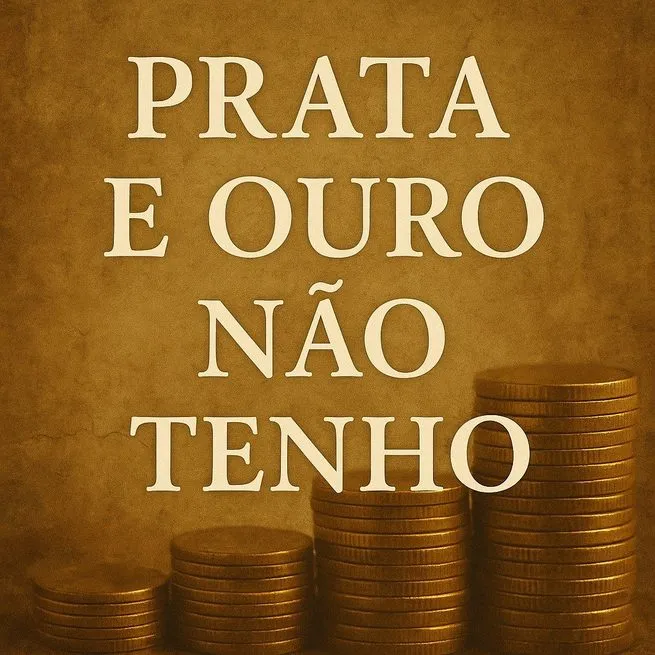
When Peter Had Nothing, and Everything
The spiritual truth behind the phrase attributed to Thomas Aquinas
Tradition says that Thomas Aquinas, a young friar of extraordinary brilliance, was received in Rome by Pope Innocent IV.
As they walked through the halls of the Vatican, the Pope showed him the riches gathered over the centuries, gold, works of art, relics, symbols of greatness and power.
Faced with such opulence, the Pope is said to have remarked, with a touch of pride and irony:
“Do you see, Thomas?
We can no longer say as Peter did:
‘Silver and gold I do not have.’”
And Thomas, in one of those moments when the truth cuts without wounding, is said to have answered:
“That is true, Holy Father.
But neither can we say:
‘In the name of Jesus Christ, rise up and walk.’”
We do not know if the conversation happened word for word.
But we know something greater:
this phrase has crossed eight centuries because it reveals a spiritual truth that never grows old.
When we gain much, we lose what is essential
The point was not the gold.
It was not the Vatican.
It was not Rome.
The point was the human heart.
Because every time a system, whether religious, political, corporate or personal, leans on:
-
structure,
-
tradition,
-
prestige,
-
stability,
-
recognition,
-
resources,
it loses what cannot be bought: spiritual authority.
Peter had nothing.
But he had everything.
Because everything he had, God had him.
The power that does not come from the hands
The miracle of Acts 3 was not found:
-
in the word “rise up,”
-
nor in a technique,
-
nor in a rite,
-
nor in an office.
The power was in the union of faith, dependence and the presence of the Spirit.
What Peter had, the institution has no way to store.
And what the institution has, Peter never needed.
This is the tension that Thomas Aquinas saw
and that is still alive today in every expression of faith.
It is not about Rome, it is about us
It would be naive to think this reflection applies only to the Vatican of the thirteenth century.
The same phenomenon appears:
-
in modern megachurches,
-
in historic denominations,
-
in independent ministries,
-
in evangelical structures that became empires,
-
in movements that began full of the Spirit and ended full of protocols.
Because the problem is not in the institution.
It is in the human being inside it.
When a man gains too much security,
he loses dependence.
When he gains a stage,
he loses brokenness.
When he gains methods,
he loses sensitivity.
When he gains power,
he loses authority.
The wealth that steals the miracle
The “silver and gold” that take away our authority is not necessarily money.
It can be:
-
prestige,
-
reputation,
-
flawless theology,
-
control,
-
tradition,
-
structure,
-
belonging to the system,
-
or the comfortable protection of the institution.
All of this is gold before men
but dust before God.
Because the Spirit does not move where man already secures himself.
The crisis that purifies power
The answer of Thomas Aquinas is a mirror for anyone who serves God:
“What have we gained that made us lose what really matters?”
This question applies to:
-
pastors,
-
priests,
-
leaders,
-
churches,
-
ministries,
-
organizations,
-
families,
-
and ourselves.
How many times have we gained “silver and gold”
recognition, influence, stability, structure
and lost the simple power to say:
“Rise up… and walk.”
Going back to Peter's place
The answer is not material poverty
it is spiritual simplicity.
It is going back to the place where:
-
the voice is clean,
-
the heart is light,
-
the ego is removed,
-
the dependence is total,
-
and God is the one who acts.
It is leaving the temple of marble and going back to Solomon's portico.
It is trading the glory of the walls for the glory of the presence.
It is replacing the institution that guarantees
with the faith that sustains.
Conclusion
The phrase attributed to Thomas Aquinas is not about Rome.
It is about the risk that accompanies every human being who draws near to power.
The question is not:
“Does the institution have gold?”
The question is:
“Do we still have authority?”
Peter had no resources.
But he had Christ.
Today we have structures, techniques, methods, ministries, strategies, influence…
And the question keeps echoing, simple and sharp:
What have we gained that made us lose what really matters?
This is God's call for our time:
to go back to the place where we have neither silver nor gold
but we have the Spirit.