The Muscle of the Soul
Meet the psoas, the 'muscle of the soul,' and how it relates to posture and emotions. A reflection on the body, fear and freedom.
Airton Humber · 23/04/25 · 3 min de leitura
The Muscle of the Soul: what the psoas reveals about us
When the body speaks, the soul answers in silence.
1. The deepest muscle in the body
The psoas is an internal, deep muscle that connects the lumbar spine to the bones of the legs. It is essential for:
- sustaining our posture,
- allowing us to stand upright,
- starting the movement of walking,
- and even influencing our breathing and digestion.
Maybe you have never heard of the psoas. It is a deep muscle, located on each side of the lumbar spine, that extends down to the bones of the legs.
See below where it is in the human body:
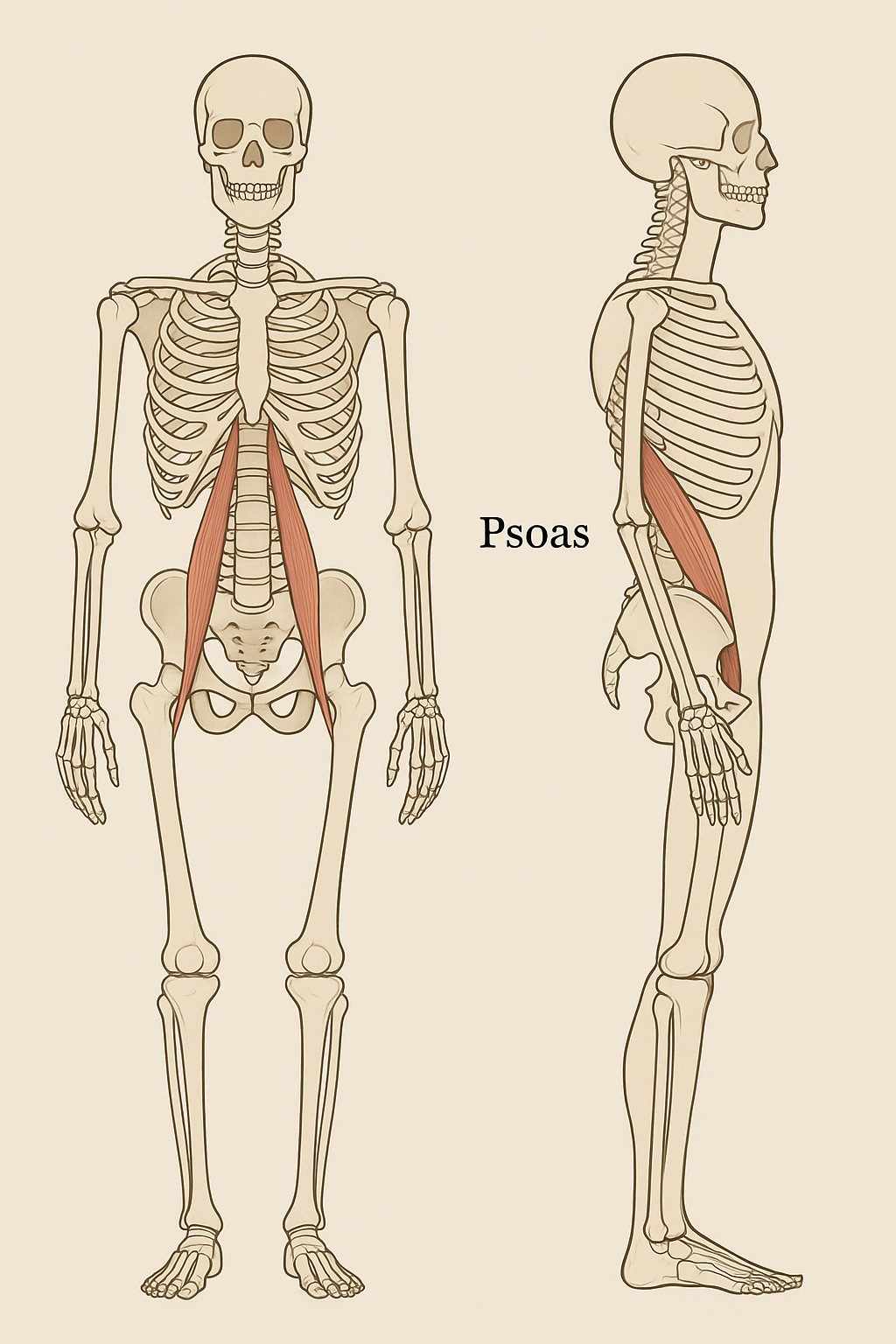
The psoas: a bridge between the center of the body and the impulse to walk.
2. But why "muscle of the soul"?
This expression does not come from traditional medicine, but from Eastern and integrative practices, such as yoga, meditation and body therapy.
In these traditions, the psoas is considered the center of our vital energy. It is connected to the belly region, where we feel fear, courage, the impulse to live. That is where the body reacts when something threatens our peace.
When we are in danger, the psoas contracts. But it also contracts with worries, tensions, difficult memories. And if it is not released, it stays tense, even when the danger has already passed.
That is why some therapists call it the "muscle of the soul": because it keeps our deepest memories. Memories that the body has not forgotten, even when the mind has already moved on.
3. The center that shrinks
Maybe you have never heard of the psoas. But you may well have felt what it does. That tightness deep in the belly. The short breath. The stiffness that settles in for no apparent reason. It is as if the body were curling inward, even when we are trying to keep our heads held high.
This muscle is connected to the spine, the pelvis, the diaphragm. It reacts to fear, to stress, to trauma. And it also pulls back when there is pain, sadness or constant vigilance.
It is not just a muscle. It is a silent sentinel.
4. The psoas and parkinsonism: my crossing
I have a condition of parkinsonism. And little by little, I am noticing something that may go unnoticed by many:
It is not only the nervous system that locks up.
It is the whole body trying to protect itself.
The head leans forward. The breath gets shorter. Walking demands more effort. And, without realizing it, the center of the body, where the psoas is, stays in constant alert. Always ready. Always contracted.
That was when I began to listen to it.
Not with techniques or diagnoses, but with attention. With presence. With prayer, sometimes.
And I understood that releasing the psoas is not stretching the body, it is opening space. It is allowing the center to rest. The body to breathe. The soul to feel safe to dwell in its own body.
5. A simple exercise for listening to the body
I received this exercise suggestion and I will look into it, adding it to what I have already been doing.
- Lie on your back with your knees bent and your feet on the floor.
- Close your eyes and breathe gently, feeling the air reach the lower part of your abdomen.
- Imagine a warm river flowing from your belly down to your legs.
- Say to yourself: "I do not need to fight right now. My body can rest."
- Stay like this for a few minutes. No hurry. No goal.
Sometimes it is there, in the silence between one breath and the next, that healing begins.
6. When the body frees the soul
The psoas shows us how we have been living.
- If we are tense, it stiffens.
- If we feel insecure, it pulls back.
- If we trust, it lets go.
I know you desire truth in the inmost being; and in the heart you teach me wisdom. →
This truth that God seeks… perhaps it is also there. In the body. In the inmost being. In the place where our center dwells.