Tradition
What is tradition, and how do we break free from it? A simple and deep text about how the past can take the place of the truth.
Airton Humber · 25/01/26 · 6 min de leitura
what it is, and how to break free from it
There are things that do not hold us with chains.
They hold us with phrases.
With habits.
With customs.
With repetitions.
And the name of this is tradition.
Tradition is what passes from hand to hand, from generation to generation, from mouth to mouth…
until it becomes "truth," without needing to be true.
It can seem innocent.
It can seem beautiful.
It can seem "respectable."
But there is a moment when tradition stops being inheritance…
and becomes prison.
1) What is tradition, exactly?
Tradition is the past ruling the present.
It is when something becomes "the right thing" only because:
-
it has always been this way
-
everybody does it
-
nobody questions it
-
changing it is hard work
-
it is safer to repeat
Tradition is comfortable.
Because it frees the human being from something difficult:
discerning.
It offers a ready-made path.
A ready-made language.
A ready-made way.
And little by little, the person no longer lives by conviction.
They live by automatism.
2) Tradition outside religion (where it seems most "normal")
Tradition does not rule only in the church.
It rules the whole world.
In the family
"In our house it has always been this way."
And that's it. The phrase becomes law.
At work
"Don't come up with new ideas."
And that's it. The new dies before it is born.
In society
"That's just how it is."
And that's it. The wrong becomes normal.
And when the wrong becomes normal, the human being stops noticing.
He adapts.
3) Tradition has a dangerous power: it swaps the center of things
It does not need to destroy the truth.
It is enough to replace it.
And this happens all the time.
Santa Claus Christmas
What could point to light becomes consumption.
The center changes.
And nobody fights it.
Easter Bunny
What should bring awareness becomes chocolate.
The center changes.
And it becomes "cute."
Pleasant songs with mistaken messages
The melody is beautiful.
The emotion is real.
But the message is false.
And then a modern confusion is born:
the pleasant comes to be confused with the true…
even when it is not.
4) Tradition changes the meaning of words
This is one of the clearest signs that it has already won.
When the language changes, the mind changes.
And when the mind changes, life changes.
That is why common phrases appear, repeated naturally:
"Rest in peace."
As if rest were dying.
"To be caught for Christ."
As if Christ were a capture, and not a liberation.
"Making love."
When, many times, it is only having sex.
"Justice."
When, in practice, it is only the Law, a formal system, which is not always good, not always just.
Tradition does not only repeat.
It forms.
5) A very strong example: the word "Apocalypse"
Just mention "Apocalypse."
People shiver.
They get tense.
They prefer to avoid it.
Nobody seems to like this word.
And this reveals a hijacking.
Because "apocalypse" does not mean terror.
It means revelation.
Tradition took what should open the eyes…
and turned it into fear.
And when a word creates fear, it stops being read.
And when it stops being read, it stops illuminating.
6) In the religious context: tradition can nullify the Word
Here Jesus is direct, without detours:
"Thus you nullify the word of God, because of your tradition."(Matthew 15:6)
The Word is still written.
But it loses its central place.
And when tradition takes the center, faith becomes form.
It becomes repetition.
It becomes a "way of living" that seems right… but does not generate life.
Tradition presents itself as respect.
But it can be only fear of leaving the known.
7) What tradition hides from us: who we are
Scripture does not treat the human being as an accident.
The human being was created in the image of God.
And Eve is called the mother of all humanity.
This gives back dignity.
It gives back value.
It gives back origin.
But there is a modern phrase that seems beautiful and has become tradition:
"We are all children of God."
The biblical answer, when stated precisely, is simple:
no.
All are God's creation.
All have value as human beings.
All can be reached.
But "child of God" is not an automatic label.
It is birth from above.
Sonship is not culture.
It is not tradition.
It is not biology.
It is life.
8) The question that runs through everything: "Adam, where are you?"
After the fall, God asks a question that is not about an address.
It is about a condition:
"Adam… where are you?"
Adam did not get lost in the garden.
He got lost inside himself.
He hid.
And since then, the human being keeps repeating this in a thousand ways:
-
hiding behind appearance
-
hiding behind work
-
hiding behind religion
-
hiding behind arguments
-
hiding behind tradition
Tradition is a sophisticated hiding place.
9) How do we break free from tradition?
Liberation does not begin with force.
It begins with light.
Jesus said something impressive to Nicodemus:
first you see the Kingdom…
then you enter.
And Paul says that, for now, we see as in a mirror, dimly.
But he also says something even higher:
"All of us, with unveiled face, contemplate, as in a mirror, the glory of the Lord, and are transformed from glory to glory…"
In other words:
God does not transform the human being by pressure.
He transforms by vision.
And to begin to see, it is necessary to hear.
Because:
faith comes by hearing.
And this Word keeps washing.
It keeps washing away the lie.
It keeps washing away the confusion.
It keeps washing away the fear.
It keeps washing away the tradition that took the place of life.
Until the human being begins to see.
And when he sees…
he can no longer live the same way.
10) A small digression: eyes, mirror and light
Father Antônio Vieira said something simple and deep:
to see, three things are necessary: eyes, a mirror and light.
Without eyes, there is no perception.
Without a mirror, there is no reflection.
Without light, nothing becomes visible.
And this fits perfectly with faith.
There are things that do not change in us because we still do not see them.
Tradition lives on repetition in the dark.
But when the light arrives, the mirror shows, the eyes perceive…
and the human being can finally walk.
11) The Way: faith is not theory, it is direction
And there is a simple detail that we almost always forget.
The early church was not known as "the church of theory."
It was known as the Way.
Because the Gospel is not only a correct idea.
It is a life that is walked.
And that is why the Word of God is not presented as a burden…
but as light.
Light for what?
For the way.
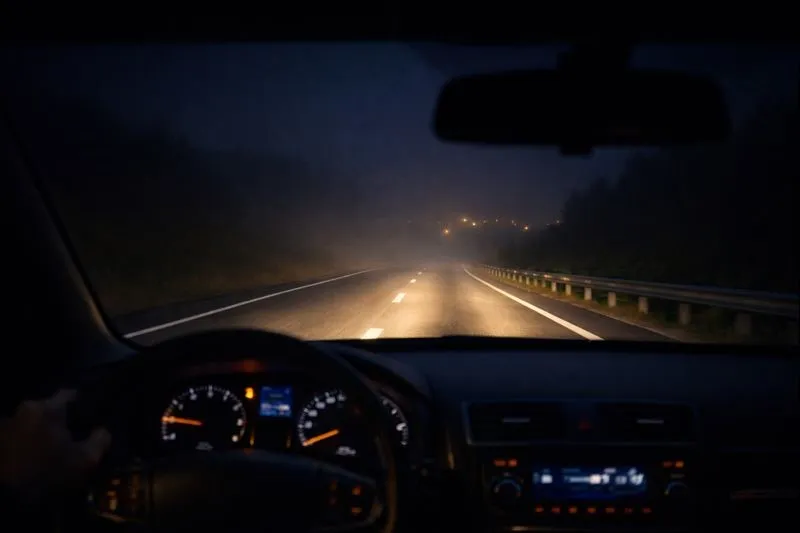
Walking by faith is very much like driving at night.
You do not see miles ahead.
You see only a few meters.
But that is enough.
Because the light does not show you the end of the road.
It shows you the next stretch.
And, going on like this, stretch after stretch
you can go very far.
Tradition wants to give you the feeling of total control.
Faith does not.
Faith gives you direction.
And direction, when it comes from God, is safer than any ready-made map.
12) "Who is this Son of Man?", and the answer was: walk in the light
There is a moment when they asked Jesus:
"Who is this Son of Man?"
And Jesus' answer was surprising.
He did not answer with theory.
He answered with a way.
He said, in essence:
walk in the light while you have the light.
They wanted a definition.
Jesus offered a direction.
Because the Kingdom is not a subject to win in a debate.
It is a life to walk.
The light is not a concept.
It is direction.
And when a person does not walk, tradition takes the place of movement.
But when they walk in the light, even seeing only a few meters ahead
they go far.
Because the light guides them.
13) And the "go"… maybe it is "going"
There is a phrase of Jesus that many people learned as a burden:
"Go into the world…"
But maybe the more real meaning is this:
going.
While you go.
While you walk.
While you live.
While you meet people.
Not as religious advertising.
But as testimony.
Because the Gospel is not an event.
It is a life in motion.
Tradition likes what is standing still.
What is automatic.
What is repeated.
But faith is a walk.
14) And what if the "go" is a mirror?
There is a very personal curiosity that began to follow me.
Jesus said:
"Go into all the world and preach the gospel to every creature."
And I began to suspect that this phrase is not only an external order.
Maybe it is also a mirror.
Because when I hear it, something inside me appears.
Sometimes joy does not appear.
Weight appears.
Sometimes life does not appear.
Pressure appears.
Sometimes freedom does not appear.
Fear appears.
And then I realize that maybe the problem is not in the "go"…
but in the way tradition transformed the "go."
Because the Gospel is good news.
And good news does not enslave.
It calls.
It illuminates.
It guides.
And maybe the "go" is not a push to manufacture evangelism,
but the natural overflow of someone who is walking in the light.
Going.
Living.
Meeting people.
And letting life speak.
Conclusion: tradition says repeat. the Spirit makes you see.
Tradition says repeat.
The Spirit makes you see.
And when the human being sees…
he comes out of hiding.
Because liberation is not a technique.
It is a return.
A return to the truth.
A return to life.
A return to the simple place where God still asks, with love and reality:
"Where are you?"