Do you know when you do evil?
Do you know when you do evil? A biblical reflection on our Judases, religious tradition, spiritual blindness and the forgiveness revealed on the cross.
Airton Humber · 24/01/26 · 4 min de leitura
Why do we do evil?
Do you know when you do evil?
Most of us would answer: “Of course I know.”
But the Scriptures suggest otherwise.
They reveal that, many times, evil does not happen because someone “wants to be bad.”
It happens because someone does not realize what they are doing.
And maybe that is the hardest point to accept:
evil rarely presents itself as evil.
Evil almost never comes looking like evil
If evil came with a warning on its forehead, no one would choose it.
But it comes in disguise.
It shows up as “prudence.”
As “common sense.”
As “protection.”
As “necessity.”
As “it's not worth stirring that up.”
It comes like this:
-
“it's nothing serious”
-
“just this once”
-
“better to let it be”
-
“it has always been this way”
-
“this is going to cause trouble”
-
“let's keep the peace”
And, when we realize it… we have already done it.
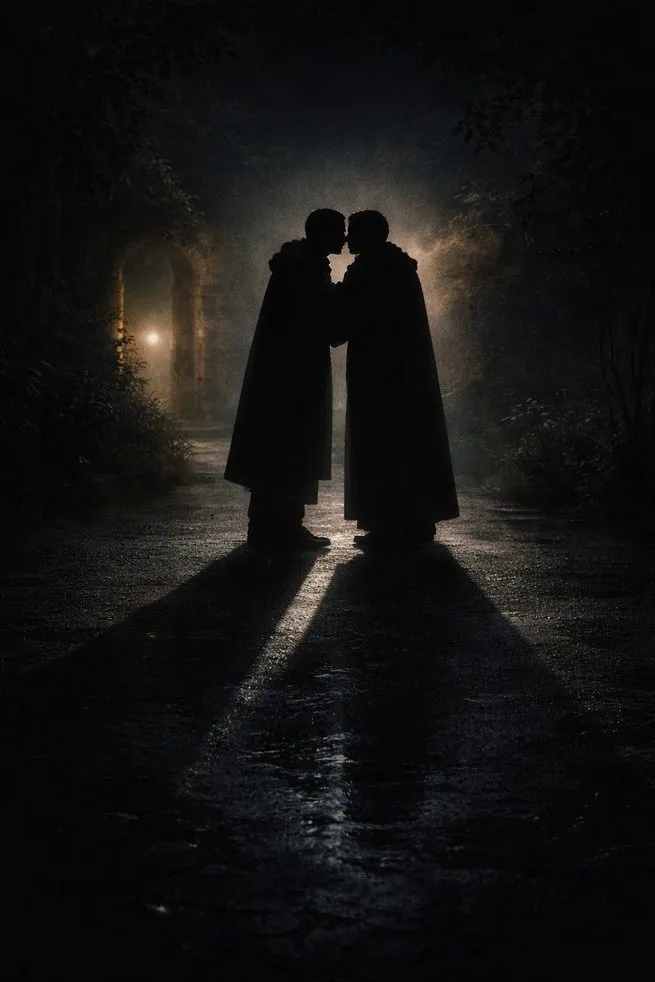
Judas did not betray with violence
Judas betrayed with a kiss
Judas does not appear in the Bible as someone far from Jesus.
He was close.
He walked alongside.
He took part.
And at the decisive moment, he does not raise a sword.
He kisses Jesus.
A gesture of friendship.
A sign of closeness.
An appearance of love.
But it was betrayal.
And then Jesus answers with a sentence that is impossible to ignore:
“Friend, do what you came to do.”
(Mt 26:50)
Jesus calls Judas friend.
And that does not happen because Jesus did not know.
John records that Jesus knew:
“one of you is a devil.”
(Jo 6:70)
In other words: Jesus is not confused.
He is lucid.
And even so, He speaks cleanly.
What is a friend, according to Jesus himself?
Here the Scriptures are extremely precise.
Jesus says:
“You will be my friends, if you do what I command you.”
(Jo 15:14)
So notice:
-
Jesus defines a friend as one who obeys
-
and calls Judas “friend” at the moment Judas disobeys
This reveals something frightening:
it is possible to be near…
and not be with Him.
It is possible to have the language of friendship…
and the intention of betrayal.
It is possible to kiss…
and wound.
“Do it quickly,” and Judas does it
John records another sentence that is even more disconcerting:
“What you are about to do, do it quickly.”
(Jo 13:27)
Jesus is not “teaching Judas to sin.”
He is bringing to light what Judas has already decided inside.
As if He were saying:
“Stop acting.
Own it.
Reveal it.
Do it.”
And Judas does it.
And John closes with a short, cold and perfect sentence:
“As soon as he received the bread, Judas went out. And it was night.”
(Jo 13:30)
It was night.
Not only on the outside.
Judas was very close… and chose tradition
Many people look at Judas and think:
“I would never do that.”
But Scripture does not record Judas so that we may find a distant villain.
It records Judas so that we may see a human possibility.
Judas was very close to Jesus.
He heard living words.
He saw the Kingdom in action.
And even so, he chose to betray.
And what Judas chose in that moment was not just “a mistake.”
He chose a security.
He chose the convenience of a system.
The predictability of a tradition.
The false peace of the familiar.
He chose the path where religion already knows how things work:
authorities, agreements, ready-made language, control.
And this is frightening, because it shows that it is possible to be close to the truth…
and still prefer what is comfortable.
Why do we do evil?
Because evil does not begin in the act.
It begins within.
It begins when the heart tries to protect itself.
When fear governs.
Fear of losing.
Fear of being rejected.
Fear of being alone.
Fear of paying the price of truth.
Fear of leaving the familiar.
And then the human being does what he always does:
he tries to save himself alone.
And when he tries to save himself alone… he betrays.
He betrays the truth.
He betrays conscience.
He betrays love.
Sometimes with beautiful words.
Sometimes with silence.
Sometimes with a kiss.
The cross reveals the heart of God
At the center of the cross, Jesus says:
“Father, forgive them, for they do not know what they are doing.”
(Lc 23:34)
This sentence does not diminish evil.
It reveals the diagnosis:
whoever does evil often does not know what he is doing.
He knows the gesture…
but does not see the spirit.
He knows the act…
but does not perceive the abyss.
And that is why the central message of the cross is so high:
God did not come to crush the guilty.
God came to save the blind.
The Gospel is not the condemnation of the traitor
It is the salvation of the traitor
The beauty of the Gospel is almost impossible to bear:
Jesus does not lose love even before the traitor.
He calls Judas “friend” at the crucial moment.
He does not call Judas “friend” because Judas deserved it.
He calls Judas “friend” because He is who He is.
And this reveals what God came to do:
not to condemn the world…
but to save.
To save even that part in us
that still prefers the comfortable
to the true.
This is not approval.
This is light.
It is as if Christ were saying:
“I know.
And even so, I do not become darkness.
I remain light.”
God does not defeat evil by becoming evil.
He defeats evil by remaining who He is.
So the question returns, more alive
Do you know when you do evil?
Because perhaps the most dangerous evil…
is not the blatant evil.
But the evil that disguises itself as prudence.
As tradition.
As common sense.
As “it has always been this way.”
The kiss.
And if you have begun to see… the healing has already begun
The light did not come to humiliate.
It came to save.
The Gospel is not the announcement that there are bad people.
It is the announcement that God enters our night…
and still calls us friend.
And when that light turns on, something new happens:
the heart stops saving itself alone.
And finally learns to trust.