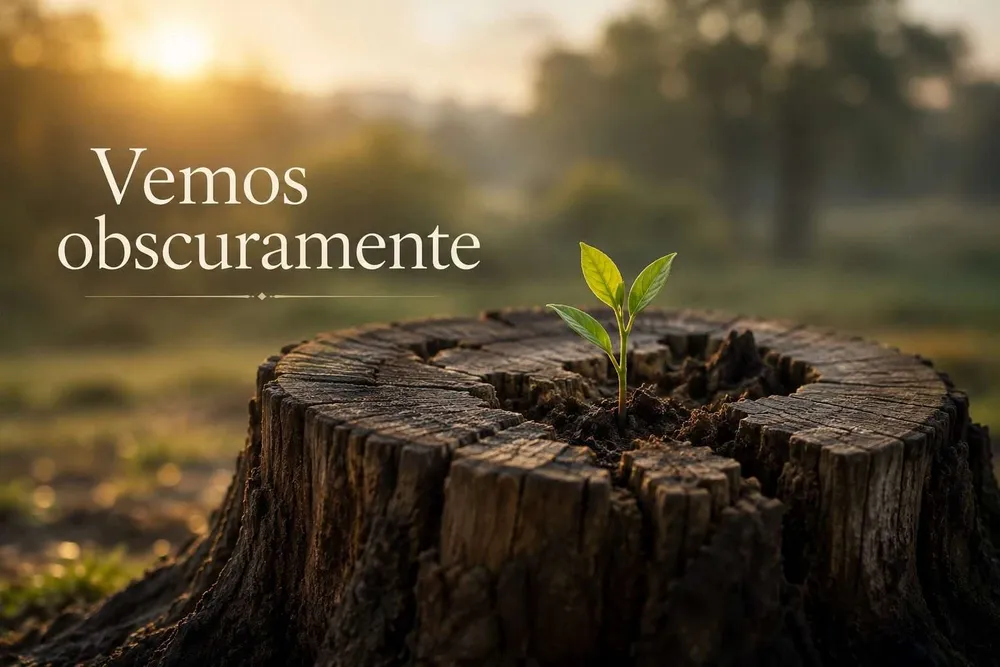
We See Dimly
We see the mistakes, the past and what is left. But we see only in part. We see dimly. A reflection on learning to see our brother, the holy seed and the Kingdom of God.
Airton Humber · 27/08/26 · 4 min de leitura
Paul wrote:
“Now we see as in a mirror, dimly… Now I know in part.”
Perhaps these words are not only about how little we still know of God.
Perhaps we also need to remember them when we look at the other person.
Because we can look at someone and believe we know exactly who he is.
We see his mistakes.
We see his story.
We see what he did.
And we think we have seen the whole man.
But perhaps we are still seeing dimly.
The stump and the seed
Isaiah saw the Lord.
And, before him, his first perception was not about others:
“Woe is me!… I am a man of unclean lips.”
Then Isaiah is sent to a people who look but do not perceive; who hear but do not understand.
And he asks:
“How long, Lord?”
The answer is harsh.
The cities would be laid waste. The houses would be left uninhabited. The land would be ruined.
The tree would be cut down.
It seemed like the end.
But it was not.
“After they are cut down, a stump still remains; so the holy seed is its stump.”
We can look at a felled tree and see only a stump.
God can still see the holy seed.
What did they see?
On the cross there was a condemned man.
Wounded.
Humiliated.
Hanging on a tree.
Many looked.
One of the criminals beside him also looked, and mocked.
But the other looked at the same crucified man and said:
“Jesus, remember me when you come into your Kingdom.”
What Kingdom was he able to see there?
There was no throne.
There was no army.
There was no appearance of victory.
There was only another crucified man beside him.
But, somehow, he saw a King and a Kingdom.
And the centurion also looked.
He saw how Jesus died and said:
“Truly this man was the Son of God.”
Many were looking at the same cross.
But not everyone was seeing the same thing.
This brother of yours
Jesus also told the story of a man who had truly been lost.
He left his father's house.
He squandered everything.
And he came back.
The older brother knew his story.
He knew what he had done.
And, when he speaks of him to the father, he says:
“this son of yours…”
He looks at the man who came back and still sees the lost one.
But the father looks at the same man and says:
“this brother of yours…”
And adds:
“was dead and has come back to life; was lost and has been found.”
The two look at the same person.
One sees what he was.
The other sees what is happening now.
The older brother is not lying about the past.
The problem is that what he sees is not everything.
He knows his brother's mistakes.
But he still cannot see:
he has been found.
Learning to see
Perhaps that is why we need to hold on to:
“Now I know in part.”
When I judge my brother once and for all, perhaps I am supposing that I see clearly.
But I do not.
I do not know everything that has happened inside him.
I do not know everything that God can still do.
Perhaps I am looking at a stump without being able to see the holy seed.
Perhaps I am looking at someone who was lost without realizing that something has already begun to be found.
And it is precisely in the same chapter where Paul says that we see dimly that he writes:
“Love bears all things, believes all things, hopes all things, endures all things.”
Love does not deny what it sees.
It does not call evil good.
It just does not presume that what it sees is everything.
Lord, when did we see you?
Jesus also spoke of people who would one day ask him:
“Lord, when did we see you?”
When did we see you hungry?
When did we see you thirsty?
When did we see you a stranger, in need, sick or in prison?
They had seen those people.
But they had not realized who was standing before them.
And Jesus answers:
“What you did for one of the least of these brothers of mine, you did for me.”
Perhaps this is one of the deepest questions we can ask before another person's face:
What am I seeing?
I may be seeing only a poor man.
A prisoner.
A stranger.
A lost one.
A stump.
And perhaps I have not yet learned to see:
“one of these brothers of mine.”
John wrote that whoever does not love his brother, whom he sees, cannot love God, whom he does not see.
Perhaps learning to see the invisible God and learning to truly see the visible brother are much closer things than we imagine.
Jesus said to Nicodemus:
“No one can see the Kingdom of God unless he is born again.”
And then he spoke about entering the Kingdom.
Perhaps learning to enter also involves learning to see.
And there is something very beautiful in the story of the two brothers.
The son who was lost came home.
The father throws a feast.
But the older brother stayed outside.
The father went out to meet him too.
And tried to make him see:
“this brother of yours…”
It was necessary to rejoice.
It was necessary to celebrate.
Because the one who was lost:
has been found.
Perhaps, sometimes, it is not the lost one who remains outside.
It may be the one who has not yet been able to see that his brother has been found.
Today we still see as in a mirror, dimly.
We see the mistake.
We see the wound.
We see the past.
We see the stump.
But perhaps we still cannot see the holy seed.
That is why love waits.
And perhaps learning to see the Kingdom of God begins this way too:
by learning to look again at the face of our brother.
Bible references:
Isaiah 6:1–13; Luke 23:39–43; Mark 15:39; Luke 15:11–32; Matthew 25:31–46; John 3:3–5; 1 Corinthians 13:7,9–13; 1 John 4:20.
Related articles: